Monday, September 28, 2020

RETURN TO THE 36TH CHAMBER: Kung-Farce

This review is the third in a Martial Arts Movie retrospective commissioned by Arthur Robinson. Many thanks to Arthur for supporting Post-Credit Coda through our Patreon. All other film reviews in this retrospective will be found here. The first 36th Chamber review is here.

Director: Chia-Liang Liu
Writer: Kuang Ni
Cast: Chia-Hui Liu, Lung Wei Wang, Hou Hsiao, King Chu Lee
Runtime: 99 mins.
1980

In 1973, legendary spaghetti western director Sergio Leone decided to try his hand at comedy. The result was My Name Is Nobody, which he considered to be "a Sergio Leone film directed by someone else." He conceived of the film and handed it off to his loyal disciple Tonino Valerii. It's about a man named Nobody who tries to convince his idol to take on the Wild Bunch. It's a piss-take on Leone's typical mythic melodrama, bastardizing those elements with wordplay, farce, and goofy bits. Although the strongest pieces of the movie shine, it's a bit of a failed experiment. I remember the fun meta-commentary; I also remember the endless scene based entirely around a painfully long fart joke.

Return to the 36th Chamber shares a lot with My Name Is Nobody: it is a reworking of a genre masterpiece from a genre master that blends its signature style with farce, to diminished effect. There are two key differences, the first being that The 36th Chamber of Shaolin's director and star both return for the sequel. The second difference is that Return ultimately succeeds in its project.

Saturday, September 26, 2020

PHANTOM OF THE PARADISE: Let Music Set You Free

This review was requested by Brian Kapustik. Many thanks to Brian for supporting Post-Credit Coda through our Patreon.

Director: Brian De Palma
Writer: Brian De Palma
Cast: William Finley, Paul Williams, Jessica Harper, Gerrit Graham, George Memmoli
Runtime: 91 mins.
1974

Phantom of the Paradise is as scatterbrained as its Wikipedia genre description: 'a rock musical horror comedy film.' It begins casually enough, with an opening voiceover by none other than "The Twilight Zone" voice actor Rod Serling about the infamy of Swan (Paul Williams). This titanic music producer has a stranglehold on the industry, Serling tells us, one that he wants to enrich with his new music club, The Paradise. That monologue lasts about a minute. Then we are dumped into a whirligig of stimuli as an unseen Swan watches potential musical headliners from the balcony. Swan's current cash cow, Beach Boys throwback band The Juicy Fruits, just won't do for the Grand Opening. He needs something new.

He falls in love with the music of our protagonist Winslow (William Finley), which Winslow explains is a cantata inspired by Faust.* Trouble is, Swan needs the music, not the musician. He screws Winslow out of his intellectual property in a transparently one-sided deal that really should have been obvious to Winslow considering his obsession with Faust.

*We see snippets of Winslow's cantata throughout, as well as other music acts. The Paul Williams-produced soundtrack is exactly right for what the movie is doing.

Our first indication that we're in for something bonkers comes a few minutes in, when hired muscle and talent headhunter Philbin (George Memmoli) turns to the camera and addresses us directly-- as if we ourselves are Swan. In most films a stroke this bold this early would be a statement of intent: expect more of this style to come. Here, neither voiceover nor direct address appear in the rest of the movie because it is busy advancing every other experiment it can think of. Paradise shifts its identity every scene like a quantum particle: we can never pin down exactly where it is, and we don't know how it got there, but it never becomes anything other than itself.

Tuesday, September 22, 2020

UNFRIENDED: Hyperlink Theatre

This review was requested by Marcus Michelen. Many thanks to Marcus for supporting Post-Credit Coda through our Patreon.

Director: Levan Gabriadze
Writer: Nelson Greaves
Cast: Shelley Hennig, Moses Storm, Matthew Bohrer, Renee Olstead, Jacob Wysocki, Courtney Halverson, Heather Sossaman
Runtime: 83 mins.
2015

In the late 1800s Sigmund Freud made the revolutionary claim that hysterical symptoms are not rooted only in the physiological, but issue from trauma undergone at some point in the past. Hysteria is a social disease, and must be dealt with on psychosocial terms. These studies in hysteria would unlock his theories of repression and the unconscious mind, thus inventing the framework for an entirely new understanding of the human personality. Freud argues that human behavior is never surface level; it is shrouded from ourselves by ourselves. Our pathologies exist at the nexus of personality and patriarchy, body and politic.

Today we understand that the condition Freud's contemporaries called "hysteria" was a cobbled together mass of quackery and convenient sexism. Freud's work redefines hysteria as a pathological snag in the relationship between our conscious and unconscious mind. Trauma displaces desire, and hysterical symptoms tattletale on the parts of our mind that we don't have access to. It is the job of the analyst to circumvent a patient's denial of that trauma by closing the narrative circuit.

I am invoking Freud's work to better discuss Unfriended, which is an unprecedented work in its own right. So unprecedented that it may be the only feature film of the 21st century so far to invent an entirely novel way of telling stories. I have yet to hear a term for the medium pioneered here, so I call it Hyperlink Theatre. With one ignorable exception, the entirety of the film takes place within the interface of the protagonist's computer display. We follow Blaire (Shelley Hennig), more specifically Blaire's cursor, as she clicks around social media and talks to the floating Skype heads of her friends. No edits, and arguably no 'cinematography,' as the filmmakers cannot adjust the camera, only futz with the 'production design.'

In the year of our Lord 2020, the innovation on display here might fail to wow us. These plaguey days, theatre has made an awkward transition to a similar style of floating head Zoom storytelling out of necessity. Not to mention the meteoric rise of Twitch, a new medium that has rewired our brains so much that it makes Unfriended's unique interface seem pedestrian. At the time, though, this film came as a blistering insight.

Monday, September 14, 2020

A PRAIRIE HOME COMPANION: Once Upon a Time in the Midwest

This review was requested by Nate Biagiotti. Many thanks to Nate for supporting Post-Credit Coda through our Patreon.

Director: Robert Altman
Writer: Garrison Keillor
Cast: Garrison Keillor, Meryl Streep, Kevin Kline, Virginia Madsen, Woody Harrelson, John C. Reilly, Maya Rudolph, Lindsay Lohan, Lily Tomlin, L.Q. Jones, Tommy Lee Jones
Runtime: 105 mins.
2006

As far as subject matter goes, your enjoyment may vary depending on how into white people singing about rhubarb you are. The down home aw shucks folksy podunk salt of the earth wisdom of the dirt vibe is not my favorite, and this movie is nearly two hours straight of it. For this is the final night of the live radio play "A Prairie Home Companion," whose theater has been bought out by A Corporation. The film more or less matches the runtime of the play, so we are constantly flitting between charming old people singing charming songs and charming old people swapping charming backstage banter. The troupe expresses their grief at the closure in a panoply of ways, while Garrison Keillor (or "GK" as the movie styles him) occupies the center of it all, stalwart and stubborn about performing his job exactly as he always does.

Like all great art, A Prairie Home Companion is about far more than its topic. You don't have to be a fan of musical cowboys telling lewd jokes about erections to appreciate art about the people who brought such a thing into existence. What's interesting about the show within the movie is the way it telescopes the personal stories of performers who have been intimately tied to the production for decades. Keillor knows that stories are about people foremost, and director Altman obliges in shaping a tricky, busy script into something successfully personal.

Friday, September 11, 2020

PALM SPRINGS: You May Kiss the Now

Director: Max Barbakow
Writer: Andy Siara
Cast: Andy Samberg, Cristin Milioti, J.K. Simmons
Runtime: 90 mins.
2020

How do you show the passage of time onscreen? How do you shape an era, or an eon? How do you characterize the empty periods, the boring moments? How do you establish an existential weight? Films only have an hour and a half* to tell their story. They don't carry the same longevity or interiority as a novel.

*or three and a half if you're producing a contemporary blockbuster

Palm Springs makes the void of time its entire project, and it communicates that void almost entirely through implication. Nyles (Andy Samberg) has been stuck in a classic Groundhog Day-style time loop at a wedding in Palm Springs. Though he is our protagonist, our perspective character is Sarah (Cristin Milioti), sister of the bride. Nyles tries to seduce her and accidentally gets her stuck in the same time loop. There is no choice but to introduce her to the life of nihilism and dull despair that he has been living for cycles beyond count.

Palm Springs is an Andy Samberg comedy, but it's not about the goofy time loop jokes (though there are plenty good ones, like Nyles's infinitely bored sexual explorations). Instead it is a character study first and foremost, a rather subtle one that ought to cement Samberg on the long list of comedic actors with immense dramatic talent. Samberg doesn't play the buffoon here. Maybe Nyles was once a buffoon, but any antic energy has long since withered into acid irony. The luster has left Nyles's life long ago; the bare minimum is all he can muster. Even when he's navigating a perfect sequence of moves across the dance floor, or grabbing the attention of the room with a surprising speech, his eyes are hollow. There's a sense that anything he can do is always already played out.

Thursday, August 20, 2020

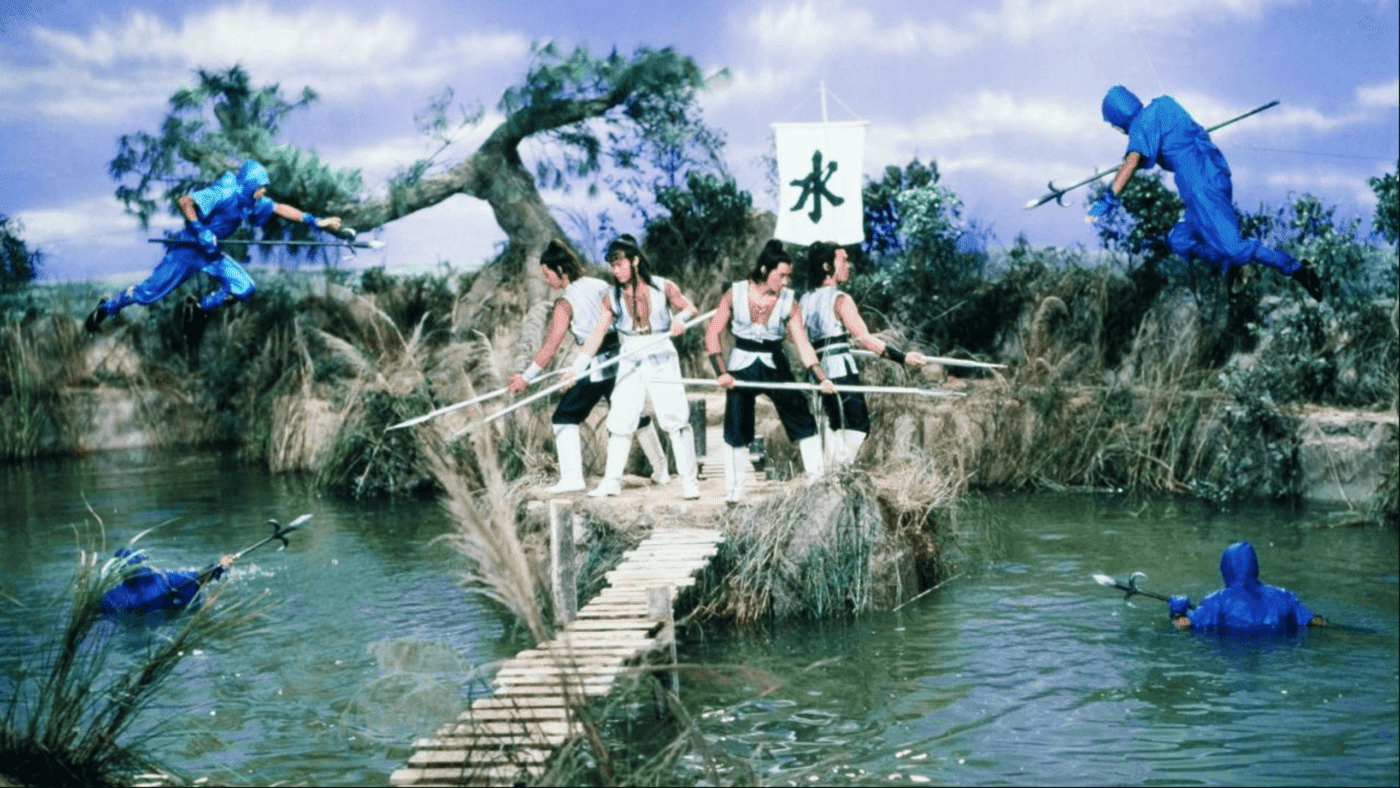
FIVE ELEMENTS NINJAS: Elementary School

This review is the second in a Martial Arts Movie retrospective commissioned by Arthur Robinson. Many thanks to Arthur for supporting Post-Credit Coda through our Patreon. All other film reviews in this retrospective will be found here.


Director: Cheh Chang
Writers: Cheh Chang, Kuang Ni
Cast: Tien-Chi Cheng, Pei-Hsi Chen, Tien Hsiang Lung, Meng Lo, Michael Wai-Man Chan, Li Wang
Runtime: 107 mins.
1982

Here is my best effort at a Five Elements Ninjas plot summary: the film begins with a fight between an established dojo and an upstart group of criminal combatants. The established dojo wins handily. In the process they defeat a Japanese samurai, who commits seppuku in shame. Before he dies, he reveals the existence of the Five Elements Ninjas, experts in ninjutsu who use themed subterfuge techniques to best their opponents. The kung fu dojo sends groups to fight each of these squads. They are all murdered. Then, aided by the betrayal of ninja spy Senji (Pei-Hsi Chen), a ninja invasion force murders all of our characters except one. Shao Tien-Hao (Tien-Chi Cheng) escapes and finds a ninjutsu mentor. After a brief montage, he returns with his own squad to wipe out the Five Elements Ninjas and restore his fallen dojo's good name.

It's all nonsense. The plot exists as an excuse for the fight scenes. The characters, too, add nothing of value. The most fleshed out dynamic by far is between protagonist Shao Tien-Hao and Senji. Senji postures as an abused woman in order to gain entry into the martial arts school, where she betrays them by orchestrating the ninja invasion from the inside. She is secretly a proficient ninja in her own right, but she has (surprise surprise) fallen in love with Shao Tien-Hao, who is nothing but rude and officious towards her. Their entire arc together is rife with smug misogyny. If these are the most developed characters of the bunch, well, don't expect much in the way of human drama.

Wednesday, August 19, 2020

What Is a Puppet?

Nate Biagiotti commissioned a piece on Puppets in Film. This interview is the product of that exploration. Many thanks to Nate for supporting Post-Credit Coda through our Patreon.

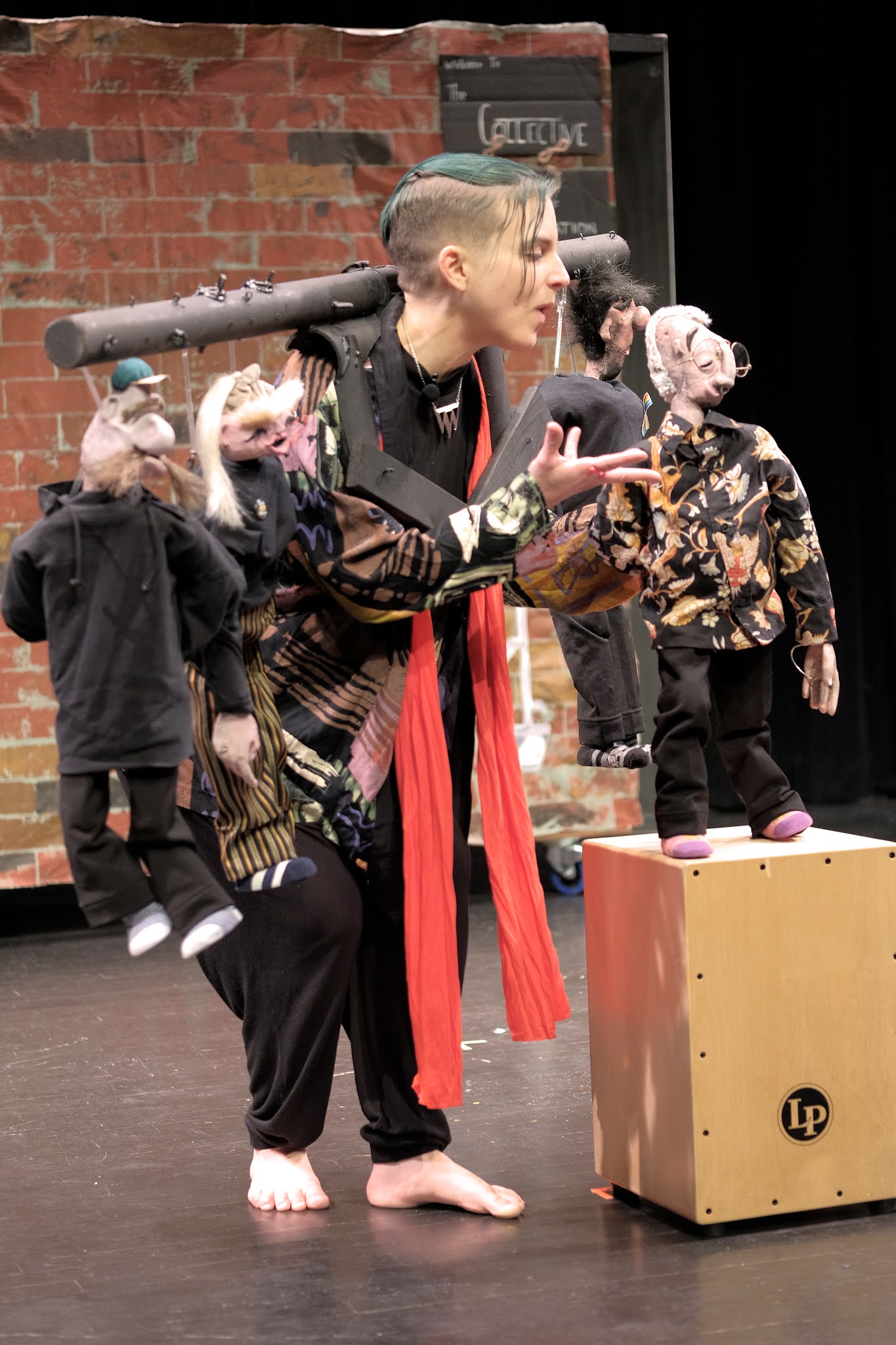
Taylor Cawley as Athena + The Collective in The Medusa Play. Directed by Ryan Rebel and Ang Bey. Puppet design by Jo Vito Ramírez. Find their work at jovitoramirez.net

RYAN REBEL: I'm here with my friend Jo Vito Ramírez to talk about puppets in film. Tell me about what makes you a puppet person and why you're so qualified to be here.

JO VITO RAMÍREZ: Hey, take it easy. The easiest answer is that I make and use puppets and I have for years.

RYAN: Jo is a phenomenal puppet builder, they've made puppets for my plays and many others. They're constantly adapting and learning new things, trying to make the form and content functional together. So we can think about form and content with these clips, and whether we like the puppets or not, if they work, what is puppet and what isn't.

JO: Ooh that's great, we should look up the definition.

RYAN: "A movable model of a person or animal that is used in entertainment and is typically moved either by strings controlled from above or by a hand inside it."

JO: Wow. That is too narrow! That's terrible. That's not true at all. Only an animal or person? Strings above or hand inside it? So a simple rod puppet wouldn't even exist. Like that little wormy boy in Sesame Street. That would be rod from beneath, so it wouldn't fit this definition.

RYAN: Some of these clips might blur the lines, so I'm curious what you'll think. Let's watch the first one.

Saturday, August 15, 2020

THE MUMMY vs. THE MUMMY: A Guide to MUMMYfication

This critical comparison of The Mummy (1999) and The Mummy (2017) was commissioned by Carson Rebel.  Many thanks to Carson for supporting Post-Credit Coda through our Patreon.


Director: Stephen Sommers
Writers: Stephen Sommers, Lloyd Fonvielle, Kevin Jarre
Cast: Brendan Fraser, Rachel Weisz, John Hannah, Arnold Vosloo, Kevin J. O'Connor
Runtime: 124 mins.
1999

Director: Alex Kurtzman
Writers: David Koepp, Christopher McQuarrie, Dylan Kussman, Jon Spaihts, Jenny Lumet
Cast: Tom Cruise, Sofia Boutella, Russell Crowe, Annabelle Wallis, Jake Johnson
Runtime: 110 mins.
2017

The Mummy (1999) was released by Universal to mixed positive reviews, and has since achieved a passionate cult following. The Mummy (2017) was released by Universal to near universal vitriol. This is a critical comparison of the two films. To guide the conversation we will employ the eleven steps of Mummy Creation, as articulated by this mylearning.org article.

Tuesday, August 4, 2020

A CHRISTMAS PRINCE: There's No Place Like a Minor European Hegemony for the Holidays

This review was requested by Maddie Brady. Many thanks to Maddie for supporting Post-Credit Coda through our Patreon.


Director: Alex Zamm
Writers: Karen Schaler, Nate Atkins
Cast: Rose McIver, Ben Lamb, Alice Krige, Honor Kneafsey, Sarah Douglas, Emma Louise Saunders, Theo Devaney, Daniel Fathers, Tahirah Sharif, Amy Marston, Joel McVeagh
Runtime: 92 mins.
2017

Amber (Rose McIver) is a reporter who just can't seems to get her big break. She gets an opportunity to cover the press conference of a playboy prince, which she hopes will be her big break. When she arrives she discovers no big break whatsoever, as the prince is a no-show. Instead of leaving with the rest of the press, she infiltrates government property, photographs some suits of armor, and when she is caught she conveniently steps into the identity of Princess Emily's American tutor who was expected soon but not this soon. Armed with identity fraud, she launches a campaign of reconnaissance and subterfuge, all the while falling deeply in love with the conflicted Prince Richard (Ben Lamb) in the process. This is all treated as light farce.

What kind of country is Aldovia? Who governs the people and how? The King is dead, yet the Queen's only role is to show up and deliver zingers every once in a while? Are the royalty figureheads, or is this a full-on monarchical hegemony? Is there some sort of elected Parliament that we are not given access to?

On second thought it would feel inappropriate to learn any of the political reality of this nation, because Aldovia is the stuff of pure, uncut fantasy. White, middle-class fantasy to be specific, wealthy enough to crave the touch of old money prestige, poor enough to buy into the monarchy as anything other than stuffy rituals and child sex trafficking scandals.

Monday, August 3, 2020

ONLY LOVERS LEFT ALIVE: Fangs for the Memories

This review was requested by Angela Bey. Many thanks to Angela for supporting Post-Credit Coda through our Patreon.


Director: Jim Jarmusch
Writer: Jim Jarmusch
Cast: Tilda Swinton, Tom Hiddleston, Anton Yelchin, Mia Wasikowska, Jeffrey Wright, Slimane Dazi, John Hurt
Runtime: 123 mins.
2013

Only Lovers Left Alive states its intent immediately. The needle drops on a record and the camera spins out into a lugubrious montage of two extremely stylish ethereal beings. They languish as the camera rotates above them, and the turntable pours out arabic-gothic-psychedelic rock. Nothing happens but tone and style, and this is what we should expect from the rest of the two+ hour runtime. You could call this a hang out movie, but generally hang outs imply events. By the time our characters actually get out for a low key night on the town, it feels like a dangerous cascade of activity.

This is the story of two undead beings, traversers of centuries, patrons of the arts, setters of trends, hermits, blood addicts, strung-out has-beens, powerful intellects the likes of which the world cannot acknowledge. They are wreathed in the loneliness of immortality. When Only Lovers Left Alive is at its best, it explores the psychology of how a half-millennium old vampire might experience twenty-first century culture and society. Its abnormal pacing invites us to warp and stretch our sense of time to scale. Unfortunately, this is only part of the film. The other part is a ceaseless parade of cheeky references.