Friday, December 11, 2020

CHUNGKING EXPRESS: Paranoia Agent

This review was requested by Nate Biagiotti. Many thanks to Nate for supporting Post-Credit Coda through our Patreon.

Director: Kar-Wai Wong
Writer: Kar-Wai Wong
Cast: Brigitte Lin, Tony Chiu-Wai Leung, Faye Wong, Takeshi Kaneshiro, Valerie Chow, Jinquan Chen
Runtime: 102 mins.
1994

Chungking Express is a movie about intimate urban encounters. The ways we brush elbows with entire universes that we will never know. The jittering pace and the frenetic energy of a busy day or an exciting night in the city, manifested by a choppy framerate that blurs pedestrian movement and turns the film's incredible fluorescent light design into sickly rainbow smears. The city is the main character, maybe the only character.

That city is Hong Kong, though it's as much about Every City as it is about the particularities of HK. The movie settles us in with some noir voiceover from our supposed protagonist, known only as Cop 663. Beat cop, lovelorn romantic, a mysterious woman of crime in a blonde wig... Chungking has all the ingredients of a tidy little thriller. Then it takes those ingredients, throws them at the wall, and does a little softshoe routine to smear them across the kitchen tiles.

Tuesday, December 1, 2020

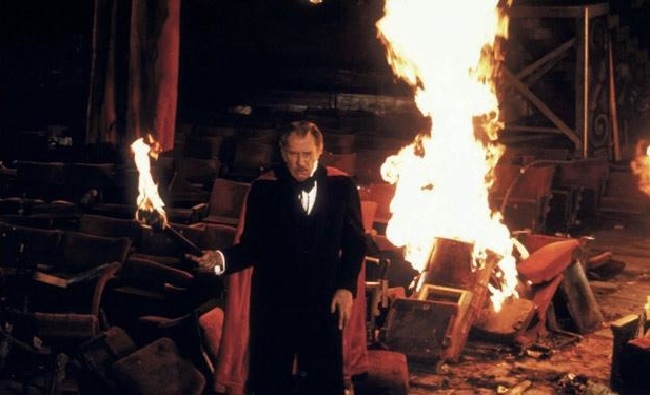
THEATRE OF BLOOD: The Bard's Price

This review was requested by Brian Kapustik. Many thanks to Brian for supporting Post-Credit Coda through our Patreon. Be warned, spoilers abound.

Director: Douglas Hickox
Writers: Anthony Greville-Bell, Stanley Mann (idea), John Kohn (idea)
Cast: Vincent Price, Diana Rigg, Ian Hendry, Harry Andrews, Coral Browne, Robert Coote, Jack Hawkins, Michael Hordern, Arthur Lowe, Robert Morley, Dennis Price
Runtime: 104 mins.
1973 

Theatre of Blood (also stylized as Theater of Blood depending on where you look) follows the exploits of the ghost (?) of Shakespearean actor Edward Lionheart. Lionheart has returned from death to mercilessly exterminate a cabal of theatre critics one by one, all because of their excoriating treatment of him in the papers. Each gloriously ironic killing follows the template of a Shakespeare play that Lionheart headlined in his final season. I present this review in ten segments, one for each of Shakespeare's works as represented in Theatre of Blood.

Saturday, November 21, 2020

SCHITT'S CREEK Season 1

This review was requested by Sonja Dominguez. Many thanks to Sonja for supporting Post-Credit Coda through our Patreon.

Episode 1 - Our Cup Runneth Over

Schitt's Creek is a story about opulence gouged. This cuts two ways. It's exciting to have a tiptop production quality show that is so explicitly about class in America. The emperors robbed of their clothing, and banished to a podunk town that they have ironic ownership of. We see the underside of the great American success story.

But you can't have your cake and eat it too. This show asks us to sympathize with a family of rich entitled white people, the exact folks who are killing the world hardest and fastest. Even more troublesome and potentially tone deaf is the pilot's insistence that this family's wealth is not being repossessed because of anything wrong they did, but because of the shady dealings of another (unseen) member of the clan. This retreat from responsibility means the show is likely aware of its central dilemma: How can we make a show about the redemption of rich monsters without making them so monstrous that the audience can no longer sympathize? Or to put it more bluntly... nobody makes millions of dollars without stepping on the necks of thousands of people.

The writers are therefore savvy to begin the show by emphasizing the gouge rather than the opulence. The first scene shows the government ransacking their mansion, which is both an economical storytelling choice and a way to shift our focus away from the inherent evil of millionaires.

This leads directly to the first joke of the show that really lands. The family learns that the government neglected to repossess one asset, the town of Schitt's Creek, which the family purchased as a joke. "You mean you actually bought that town? I thought you photoshopped the deed," the family says to the father, who responds, "Of course I bought the town! The joke was owning the town! Why would I photoshop the deed? The joke was owning the town!" This bit is both about the excesses of the rich, and about a father who takes having fun with his family seriously. It emerges nicely from Eugene Levy's performance, which I already like quite a bit. There are layers in the way he later overreacts to the weird but amicable presence of Roland Schitt (Chris Elliott), the greasy town mayor.

Not all the actors come off so well right away. The daughter Alexis Rose (Annie Murphy) is little more than a mediocre valley girl impression at this point, although she does get an absurdist scene that consists entirely of her saying "OK. OK. OK. OK. OK. OK." on the phone while her brother David (Dan Levy) gawks aimlessly at their new motel home.

The real highlight of the episode is its production design, especially the props. At the local diner the simple act of a waitress handing the family their enormous laminated menus completely dominates the scene. There's a gag that consists entirely of the mother Moira (Catherine O'Hara) holding a lightbulb as if it were a foreign object. And of course, her gaudy earrings that go missing and lead to this fantastic piece of dialogue: "I politely accused that girl of stealing my earrings and she turned ice cold!" I have a feeling the props design is going to be a backbone of the show, both from a design and a direction perspective. What better way to talk about the rich and the poor than showcasing the Stuff that they respectively surround themselves with?

All in all the pilot is modest, far from spectacular. That may be a smart approach, familiarizing us with the character dynamics before adding some razzle-dazzle. That focus on character means I don't yet know how the show will tackle its tricky class themes. I will be very curious to find out.

7

Thursday, November 5, 2020

IN BRUGES: Sin Stooge

This review was requested by Rafael Schneider. Many thanks to Rafael for supporting Post-Credit Coda through our Patreon.

Director: Martin McDonagh
Writer: Martin McDonagh
Cast: Colin Farrell, Brendan Gleeson, Ralph Fiennes, Clémence Poésy, Thekla Reuten, Jordan Prentice
Runtime: 107 mins.
2008

I have long wondered what to think about the very white, very male, very cis vulgarity that runs its tendrils through In Bruge's screenplay. The jokes are intentionally shocking in their casual malice. Writer/director Martin McDonagh intends protagonist Ray (Colin Farrell) to be a lovable hitman asshole with a heart of gold, which raises interesting questions: why are we in America so eager to condone and even celebrate physical violence in our media, but verbal violence is off the table? And can that verbal violence ever crack open our cultural norms in a cathartic way? Ray's brash ignorance lets him stumble into surprisingly honest conversations with people leading quite different lives. So we still wonder, does this screenplay excuse the violence of white men? Does it excoriate it? Or does it get at a truth deeper than purity politics allows-- the webs of contradiction at the heart of our culture that can only be confronted through perverse honesty? Ultimately, I don't know, but you don't get an onscreen discussion of the coming race war this raw and real unless you're willing to be offensive along the way.

Given the tone deaf treatment of race in Three Billboards Outside Ebbing, Missouri, and the uneven meta-flailing of Seven Psychopaths, it's safe to say that McDonagh's flagrantly offensive impulses only work some of the time. In Bruges is the pinnacle of the McDonagh style on film. One of the screenplay's best tricks is that each time a character delivers an offensive or inhumane joke, the movie makes a point of weaving tragedy into the joke's callback. What once struck us as humor in ill taste takes on a surprising resonance when it leads to a real relationship, a moment of intimacy, or a horrifying misunderstanding.

McDonagh is writing about flawed people, broken murderers. Ray's attitudes about others are callous, but so are his feelings about himself. The slow reveal of the way Ray masks his own pain with childish lashing out offers a keen character study. It's also a smart foil for the warmth and soulfulness of Ray's partner in assassinry, Ken (Brendan Gleeson). This is a story about condemnation, redemption, and purgatory. It's also a riproaring comedy.

Saturday, October 31, 2020

HALLOWEEN II: Boo

Check out the first review in this holiday tradition: Halloween

Director: Rick Rosenthal
Writers: John Carpenter, Debra Hill
Cast: Jamie Lee Curtis, Donald Pleasance, Charles Cyphers, Jeffrey Kramer, Lance Guest, Pamela Susan Shoop, Hunter von Leer, Dick Warlock
Runtime: 92 mins.
1981

By every conceivable measurement of artistic merit, Halloween II is inferior to Halloween. It feels like exactly what it is, a new director trying to fit into his predecessor's shoes. It doesn't help that the newbie is the undistinguished Rick Rosenthal, and the predecessor is the legendary John Carpenter. There is no panache in this sequel, no verve, just mimicry. This is apparent the moment the film starts, which retreads the ending of the first film using a lot of the same footage. Somehow it's much worse this time around. This sinking feeling is confirmed by an early replication of the much-lauded first-person tracking shot that so successfully grounded us in the implacable perspective of Michael Myers. Like a small child putting on their dad's oversized business coat and trundling out the door with an empty briefcase, this retread lacks any of the original's sense of purpose.

All griping about Rosenthal is more than deserved, but the real issue is the screenplay. Shockingly, this does come from Carpenter and writing partner Debra Hill. Maybe his directing was what made the first film special, or maybe Carpenter and Hill half-assed a project they didn't much care for, but their work on this film is almost a slap in the face to the legendary Halloween, a movie so influential that it pioneered the slasher genre of horror.

The first of many baffling choices is to bring back the only truly compelling character from the original, but sideline her for almost the entire runtime. Yes, Laurie Strode (Jamie Lee Curtis) is back, and this time she's... unconscious in a hospital bed. You see, the events of the first film did a number on her, and despite her frantic objections, the doctors have put her under. Cue Michael Myers slashing a bloody path through the city until he locates his true target once more.

Friday, October 30, 2020

GRAVE OF THE FIREFLIES: Pangs

This review was requested by Alexis Howland. Many thanks to Alexis for supporting Post-Credit Coda through our Patreon.

Director: Isao Takahata
Writer: Isao Takahata
Cast: Tsutomu Tatsumi, Ayano Shiraishi
Runtime: 89 mins.
1988

Whether Grave of the Fireflies is a movie for you depends on your relationship to escapism. If you watch movies to escape grim reality, you'll want to stay far away from Grave. The film is itself interested in escapism as a subject, but this takes the form of demonstrating with full force the unflinching, brutal reality that lurks behind blessed moments of escape. To put it bluntly, this is a film that spends its entire runtime showing you two children dying of starvation in wartime Japan, and it is physically emotionally and spiritually convincing. Only you can know whether that's something you should experience.

As for me, I am always seeking movies that can make me feel anything, even if that feeling is discomfort or outright despair. Grave presents a rich and multifaceted despair, to the point that it's hard to know exactly what to say about it. Yes, the movie succeeds in exploring miserable territory, and yes, it hurts. The experience is so worthwhile because that's not all the film does; it uses its exploration of misery to pinpoint an important conundrum of the human spirit. In our times of greatest misery, we can find true expressions of love and care to anchor us.

Thursday, October 22, 2020

THE DARK KNIGHT RISES: Batshit

This review was requested by Don Rebel. Many thanks to Don for supporting Post-Credit Coda through our Patreon.

Director: Christopher Nolan
Writers: Jonathan Nolan, Christopher Nolan, David S. Goyer
Cast: Christian Bale, Tom Hardy, Anne Hathaway, Joseph Gordon-Levitt, Gary Oldman, Marion Cotillard, Michael Caine, Morgan Freeman, Matthew Modine
Runtime: 164 mins.
2012

By all accounts, Christopher Nolan was devastated by the death of Heath Ledger. It would be garish and unproductive to speculate too much about what the third and final film in Nolan's Batman trilogy would have accomplished if it weren't for this tragedy, though we can't help but wonder. The Dark Knight Rises is a movie with heart, perhaps more than any other film in Nolan's oeuvre, but it is not a film made by an artist whose heart is invested. One can imagine a culminating film with four major factions: the police, the Batman, the ideological warfare of Bane, and the anti-ideological chaos of Joker. Such a film could have lived up to the 'battle for the soul of Gotham' moniker that Rises attempts to fulfill, and such a film may have even justified the epic two hour forty-four minute runtime. This is not that film.

What we get instead is a shaggy beast that shoots for the stars and too often lands in the mud. The predominant characteristic of the narrative is confusion. Motivations are baffling, goals are incoherent and often outright hidden, entire subplots exist detached from the movie around them, and the massive rubber band ball of themes contradicts itself too many times to count. This is most apparent in the gradual unveiling of the central villain, Bane (Tom Hardy). At first Bane and his cultists gain power by working with the corrupt corporate class of Gotham, but this is meant to hide their real plan: to empower the underclass to revolt against the rich, powerful 1%ers. This plan is, in turn, a masquerade for yet another even more secreter plan to blow up the entire city with a nuclear bomb after demonstrating to the world... that people will turn violent if they are trapped and threatened with death, I guess? This plan becomes even more convoluted when it is revealed that Bane was not its architect, but rather a lapdog for the even most secretest villain, the abysmally performed Talia Al Ghul (Marion Cotillard), daughter of the late Ra's Al Ghul (Liam Neeson), who has been disguised as a wealthy socialite, but who is actually the boss/mother/daughter figure of Bane.

Thursday, October 15, 2020

INDEPENDENCE DAY: The Arse of July

This review was requested by Nate Biagiotti. Many thanks to Nate for supporting Post-Credit Coda through our Patreon.

Director: Roland Emmerich
Writers: Dean Devlin, Roland Emmerich
Cast: Will Smith, Bill Pullman, Jeff Goldblum, Mary McDonnell, Judd Hirsch, Robert Loggia, Vivica A. Fox, Randy Quaid
Runtime: 145 mins.
1996

Independence Day, released in 1996, is the first post-9/11 movie.* A malicious Outside Threat dares to undermine our national spirit. These terrorists target recognizable monuments to demoralize the people. Meanwhile, intrepid and heroic Americans come together to fight back. It has all the ingredients of post-9/11 cinema five years before 9/11, which leads me to believe that Independence Day unconsciously functions as a blueprint for America's infamously ugly response to that national tragedy.

*There's even an onscreen countdown timer in the film that reads 9:11 at one point, for you conspiracy-minded folks out there.

This is the most famous Roland Emmerich/Dean Devlin film, and like every Roland Emmerich/Dean Devlin film, it is pretty terrible in most of the ways that count. The dialogue is empty of significance, the character arcs waffle between shabby and nonexistent, the suspense is awkwardly grafted together with countdown timers, and its premise is as basic as you can imagine. Aliens just start blowing stuff up. That's it. Independence Day does manage to succeed where it really counts for movies like this: scale and spectacle.

Saturday, October 10, 2020

IT LIVES AGAIN: It's A-Living!

This review is the third in a Larry Cohen retrospective commissioned by Nate Biagiotti. Many thanks to Nate for supporting Post-Credit Coda through our Patreon. All other film reviews in this retrospective can be found here.

Director: Larry Cohen
Writer: Larry Cohen
Cast: Frederic Forrest, Kathleen Lloyd, John P. Ryan, John Marley, Andrew Duggan, Eddie Constantine
Runtime: 91 mins.
1978

When making a sequel, especially a horror sequel, the greatest hurdle is figuring out how to make it both fresh and familiar. Horror already requires a perfect storm of plot contrivance; a sequel requires contrivance to strike twice. Mystery and novelty are important currency for suspense, and their power is tremendously diminished with each new serving of the same formula. Despite all that, Larry Cohen's sequel to It's Alive played so well with its test audiences that the producers thought the crowds were full of ringers!

It Lives Again, also known as It's Alive II, also known as It's Alive 2: It Lives Again begins with another great atmospheric opening credits sequence, this one shot using Cohen's own swimming pool. We are eased into the film with a baby shower that's just wrapping up. The parents Eugene Scott (Frederic Forrest) and Jody Scott (Kathleen Lloyd) are positively glowing with good vibes, until they notice a stranger who hasn't trickled out with the rest of the crowd. The man is Frank Davis (John P. Ryan). He tells a familiar story about a mutant baby and a social system that wasn't ready to handle it. Frank's baby may have died at the hands of the police, but there are some who believe that such babies should be cared for and studied rather than exterminated at birth. Frank has reason to believe the Scotts's baby is another such mutant, and that the government is already standing by for forced infanticide.

Thursday, October 8, 2020

THE OLD GUARD: Millennials

Director: Gina Prince-Bythewood
Writer: Greg Rucka
Cast: Charlize Theron, KiKi Layne, Matthias Schoenaerts, Marwan Kenzari, Luca Marinelli, Chiwetel Ejiofor, Harry Melling, Veronica Ngo
Runtime: 125 mins.
2020

[If you don't know anything about this movie... one of the great pleasures of the film is the reveal of the premise. I recommend it if you're looking for a solid but flawed action movie; spoilers from hereon out.]

The Old Guard is historically noteworthy: the first major blockbuster to be directed by a Black woman, and the first superhero film to explicitly portray a queer romance.* It's an embarrassment to the industry that neither happened until 2020, but that's good old white supremacist Hollywood for you.

*Give or take a throwaway gag in Deadpool 2.

The film follows four immortal mercenaries who have made it their life's work to combat evil in the world. They have fought with armies, hunted down terrorist cells, and prevented disasters under the leadership of the ancient Andromache, or as her fellow mercenaries call her, Andy (Charlize Theron). A certain FBI agent (Chiwetel Ejiofor) has learned of their existence, and is collaborating with corrupt pharmaceutical company CEO Merrick (Harry Melling) to capture the secret of immortality. The squad aren't worried about being killed thanks to their regenerative powers, but they understand that this sort of cat and mouse game inevitably leads to capture and torture. Just as the situation is getting spicy, visions of a new immortal accost their senses-- ex-marine Nile (KiKi Layne) who just survived being killed in action by an Afghani terrorist. They must convince Nile to join them on the run, or she will suffer an unenviable fate.

There's a conspicuous discordance between the two above paragraphs. Namely that the creative team on this film is extremely diverse for an action movie, yet the plot description sounds like any other white male colonizer-mindset action slugfest. The film casts an all-woman team of marines, and it portrays them as heroic warriors rather than representatives of America's violent hegemony. The film casts a renowned Black actor as an FBI agent who turns out to be one of the good FBI agents. The film villainizes the evil white CEO, but then doesn't connect his villainy to the capitalist system that created him. The film is trying to pull a fast one by serving up patriarchal white supremacist politics that hide behind a diverse coat of paint. It's the 'more female CEOs!' joke taken to its natural conclusion. This Wokewashing is arguably more nefarious because it is a way for the established order to remain structurally oppressive despite making aesthetic concessions. For that reason I don't know whether or not we should applaud these milestones. Maybe a golf clap.