Showing posts with label Captain America. Show all posts

Thursday, June 9, 2016

CAPTAIN AMERICA: CIVIL WAR - Perpetual Motion Machine

Other Reviews in this Series.


Directors: Anthony Russo, Joe Russo
Writers: Christopher Markus, Stephen McFeely
Cast: Chris Evans, Robert Downey Jr., Sebastian Stan, Scarlett Johansson, Chadwick Boseman, Daniel Bruhl, Anthony Mackie, Don Cheadle, Elizabeth Olsen, Paul Bettany, Jeremy Renner, Emily VanCamp, William Hurt, Paul Rudd, Tom Holland, Frank Grillo, Martin Freeman, Marisa Tomei, John Kani, John Slattery, Hope Davis
Runtime: 147 mins.
2016

In the month since the release of Captain America: Civil War, I have been trying to parse my feelings about the film. I've always been a sucker for comic book cinema, ever since I was weaned on Sam Raimi's Spider-Man movies,* but as I've become more discerning and my tastes have shifted, I've grown less and less comfortable with easy bankable formulas. In fact, my adoration of nerd culture in general has soured for reasons I'd prefer not to get into here.

*Spider-Man 1 + 2 still being the best pieces of superhero cinema in existence, with a sideward nod to The Dark Knight.

Over the years I've frequently pushed to redefine the arbitrary boundaries of what is fit to be included in discussions about art and academia to include certain "vulgar genre fiction" properties. I've tried to rally against biases folks have towards superhero fiction, children's movies, animation, speculative fiction, and so on. It's not about the surface level signifiers; it's about being able to meet a story on its own terms.

That being said, I've also had to flip that script on myself and confront my own delusions about properties that I wanted so badly to adore. 2012 was a watershed year for me; I had to face the one-two punch of The Amazing Spider-Man and The Dark Knight Rises, both movies that I wanted to love so badly that I was blinded to their myriad flaws. In both cases, my wake-up call came in the form of my favorite film critic, Film Crit Hulk, who wrote eye-opening screeds against both of these films. Here they are, if you're interested.

Film Crit Hulk Smash: THE AMAZING SPIDER-MAN HAS 99 PROBLEMS BUT AN UNCLE BEN AIN'T ONE

Film Crit Hulk Smash: HULK VS. THE DARK KNIGHT RISES

Monday, April 18, 2016

CAPTAIN AMERICA: Cap-turing Character

In the weeks leading up to Marvel's next blockbuster juggernaut, Captain America: Civil War, we will be looking at every cinematic iteration of those two warring rapscallions, Captain America and Iron Man.

Other Reviews in this Series.


Director: Albert Pyun
Writers: Stephen Tolkin, Lawrence Block
Cast: Matt Salinger, Kim Gillingham, Ronny Cox, Ned Beatty, Scott Paulin
Runtime: 97 mins.
1990

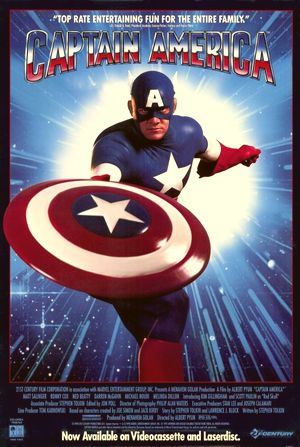
The 1990 American-Yugoslavian direct-to-video action film Captain America is the first cinematic adaptation of the character with some semblance of attention paid to the actual character. The first act plays out like a truncated version of Captain America: The First Avenger, with Cap being selected for the Super Soldier Serum, then squaring off against the Red Skull. Cap gets strapped to a rocket that he steers away from the White House and into, if I'm not mistaken, Alaska. After being frozen for about fifty years, Steve Rogers (Matt Salinger) breaks free from the ice and traipses from Alaska down through northern Canada in an attempt to find his way home. At first he does not accept that he is fifty years in the future, but this is a thematic and plot thread that predictably goes nowhere. Instead of exploring his man-outside-of-time psychology, Rogers teams up with his old girlfriend's daughter (a bit gross) and goes after the Red Skull, who is still alive and has recently kidnapped the President (Ronny Cox) because he doesn't like the President's environmental bill. Also, the Red Skull has had face reconstruction surgery since the forties so he no longer has a red skull, just an ugly face.

Captain America may engage with the iconography on the surface level, but as you can probably tell by that recap, the film isn't terribly interested in exploring why the character resonates. It probably would have been better served as a cheesy period piece, but the narrative break between WWII and present day is jarring and disappointing, especially since most of the rest of the movie involves Captain America trekking across the Canadian wilderness in his goofy suit, or sitting around in suburbia acting awfully calm for somebody who has just time traveled fifty years into the future.


The fact that the Red Skull is still around fifty years later, but has waited until now for his most dastardly plot, is also distressing from a storytelling perspective. Plus, taking away his iconic look feels like a cop out at best.

Thursday, April 14, 2016

CAPTAIN AMERICA II: DEATH TOO SOON - Camp Cap

In the weeks leading up to Marvel's next blockbuster juggernaut, Captain America: Civil War, we will be looking at every cinematic iteration of those two warring rapscallions, Captain America and Iron Man.

Other Reviews in this Series.


Director: Ivan Nagy
Writers: Wilton Schiller, Patricia Payne
Cast: Reb Brown, Connie Sellecca, Len Birman, Christopher Lee
Runtime: 83 mins.
1979

Captain America II: Death Too Soon is the 1979 sequel to the 1979 TV movie Captain America, and it is several orders of magnitude better than its predecessor. If you're in the market to watch one of these movies for camp purposes, it should undoubtedly be this one. It's not like you'll be missing anything important from the original's pointless wheel-spinning narrative.

In fact, the plot is a fair bit clearer and more straightforward. A mysterious terrorist who goes by the name General Miguel (Christopher Lee) plans to hold the entire town of Portland hostage by dropping an aging serum on their heads. Miguel is in hiding, pretending to be a prison warden at a local penitentiary. Steve Rogers (Reb Brown) must investigate a small town where something suspicious is going on, so that he might ultimately discover Miguel's location and let Captain America take care of business. Meanwhile, in an irrelevant B-plot, our favorite scientists Dr. Simon Mills (Len Birman) and Dr. Wendy Day (conspicuously replaced by Connie Sellecca--didn't this character used to be blonde??) are working on a cure for the virus. They deliver exposition ably, but fail at everything else.


The film still takes a little too long to reveal what is going on in the town, but the plot is for the most part less obtuse. This is very much to the film's advantage, because the last thing this movie should want is for us to start using our brains to figure out what is happening. Everything about the story is ridiculous, of course, but it's well within the reasonable bounds of schlock sci-fi. Steve Rogers taking time to woo a single mother and hang out at her farm with her kid is a less forgivable narrative misstep.

That being said, you can shrug that stuff off with a laugh because, unlike Captain America, Captain America II doesn't spend an ungodly amount of time on every single sequence. It sets up what it needs to, knocks it down, and awkwardly edits into the next scene. Parts of it still drag, but at least we're not watching a doofus go off motorcycle jumps for five to ten minutes at a time.

Monday, April 11, 2016

CAPTAIN AMERICA: Cap-ital Punishment

In the weeks leading up to Marvel's next blockbuster juggernaut, Captain America: Civil War, we will be looking at every cinematic iteration of those two warring rapscallions, Captain America and Iron Man.

Other Reviews in this Series.


Director: Rod Holcomb
Writers: Don Ingalls, Chester Krumholz
Cast: Reb Brown, Len Birman, Heather Menzies-Urich, Robin Mattson, Joseph Ruskin
Runtime: 97 mins.
1979

The 1979 TV Movie Captain America has a simple premise: What if Captain America's son were a selfish, imbecilic slacker? And what if we made a movie about him?

Of course, the film doesn't seem altogether aware of its own premise, as we are apparently supposed to find this man impressive and heroic. He is not. Let me lay it out for you.

Steve Rogers (Reb Brown) is a hunky behemoth who has just returned from active military service. Now that he's out, his goal in life is to drive around in his van and be lazy for the foreseeable future. He also draws. These are his sole character traits.


Thursday, April 7, 2016

CAPTAIN AMERICA: Cap Gun

In the weeks leading up to Marvel's next blockbuster juggernaut, Captain America: Civil War, we will be looking at every cinematic iteration of those two warring rapscallions, Captain America and Iron Man.

Other Reviews in this Series.


Directors: Elmer Clifton, John English
Writers: Royal K. Cole, Ronald Davidson, Basil Dickey, Jesse Duffy, Harry L. Fraser, Grant Nelson, Joseph F. Poland
Cast: Dick Purcell, Lorna Gray, Lionel Atwill
Runtime: 244 mins. (25 min. premier and fourteen 15 min. episodes)
1944

The first and most perplexing thing to note about the 1944 Captain America serial is that it has absolutely nothing to do with Captain America. When I learned about the serial's existence, I was fully anticipating a propaganda-heavy war story, especially considering the time in which it was made and released. Instead, we get the story of Grant Gardner, a District Attorney who occasionally dresses up in a red white and blue costume to fight bad guys. Sometimes he doesn't dress up though, and it's just Grant Gardner fighting them. Also, Captain America doesn't have a shield and just wastes people with his pistol. Seriously, Gardner and Captain America rack up quite an impressive body count over the course of this serial, a fact that none of the authorities seem at all concerned about.

To top it all off, Captain America doesn't seem to have any powers, and, hilariously, he just drives around in a regular car. Unsurprisingly, Timely Comics (to become Marvel Comics in the 1960s) was unhappy with Republic's blatant gutting of their character, but Republic's response was basically, "None of that stuff was in the sample pages you sent us, plus we're in production already." Film historians think Republic just pasted the Captain America likeness over a pre-existing project they had in the pipe. Thus Captain America's first onscreen appearance is aggressively non-canonical.


That doesn't make it bad, though. The serial follows Captain America's pursuit of mysterious criminal The Scarab over a 25-minute premier and fourteen 15-minute episodes. In classic cliffhanger serial fashion, each episode ends with Cap in grave danger, to be resolved in the next chapter. These serials are considered to be cinema, but structurally they're really more like proto-television.

Wednesday, July 9, 2014

SNOWPIERCER: Crazy Train


Director: Bong Joon-ho
Writers: Bong Joon-ho, Kelly Masterson
Cast: Chris Evans, Song Kang-ho, Ko Ah-sung, John Hurt, Ed Harris, Tilda Swinton, Jamie Bell, Octavia Spencer
Runtime: 126 mins.
2014 (2013 in South Korea)

In the online film community that I haunt, there has been a lot of rumbling about people going to the wrong movies. Or rather, that rumbling always exists, it has just been exacerbated recently by a few factors. Between the movie you came here to read about, X-Men: Days of Future Past, and the excellent Edge of Tomorrow (as well as the much-hyped forthcoming Dawn of the Planet of the Apes, Guardians of the Galaxy, and Mockingjay: Part 1), 2014 is turning out to be a banner year for mainstream sci-fi films--and yet, everybody and their reluctant mother is going to see the predictably steaming pile that is Transformers: Age of Indistinction.

That is why my goal in writing this particular review is to mobilize you to get out and go see Snowpiercer, a film that you likely haven't heard anything about, except perhaps snippets here and there: whispers in dark alleys, notes passed under restroom stalls, covert communiqués exchanged away from the watchful eyes of the Transformers marketing campaign.

In the world of Snowpiercer, the Earth has succumbed to a new ice age, brought about by humanity futzing with the atmosphere in an effort to counteract global warming. Now everything is dead. Cue the Snowpiercer, a massive train that contains the only remaining human life. It operates as a self-contained ecosystem that circles the entire globe once per year. All is not well on the so-called Rattling Ark, however. Our protagonists live in squalor in the tail of the train, cut off from the relative comfort and prosperity of the front-dwellers by a series of gates and armed guards. The gates only open once per day, for about four seconds, to allow the delivery of the nasty looking protein blocks that sustain the lives of the tailies. Guess what, though? Our hero, Curtis (Chris Evans), is planning a revolution! If our ragtag band of misfits can unite in order to press forward, and if they can wrest control of the Eternal Engine (that which sustains all life on the train) from the industrial despot Wilford, then they will have all the bargaining chips necessary to upset the established order.

But that's just the beginning. What sounds like a familiar plot opens out and contorts in all manner of unexpected ways--without ever leaving the cramped confines of the train.


Monday, May 12, 2014

CAPTAIN AMERICA: THE WINTER SOLDIER - The Man, the Movie, the Mythos


Directors: Joe and Anthony Russo
Writers: Christopher Markus and Stephen McFeely
Cast: Chris Evans, Scarlett Johansson, Samuel L. Jackson, Robert Redford, Sebastian Stan, Anthony Mackie
Runtime: 136 mins.
2014

Part 1: THE MAN

Captain America is a wiener.  This character trait is an established fact, as undeniable as the claim that Spider-Man is a smart-ass, or that Superman is a wiener.

Think of it this way.  Of all the people you know, how many of them would say that Captain America is their favorite superhero?  I have an inkling that the number is zero, but if not... how many of those people would have said Captain America was their favorite hero before, say, the release of The Avengers?  I feel like we've narrowed the sample size to one dude living in Colorado.

How is it, then, that Captain America: The Winter Soldier has achieved such popular and critical success, to the point that some are heralding it as the best Marvel Cinematic Universe movie to date?  And, despite this near-universal acclaim, why do people still feel the need to preface their thoughts on the movie with some variation of the phrase, "I was never a big Captain America fan, but..."?

It has to do with the history of what Captain America means.