Showing posts with label genre. Show all posts
Thursday, June 16, 2016
THE CONJURING: Home Is Where the Horror Is
Director: James Wan
Writers: Chad Hayes, Carey Hayes
Cast: Vera Farmiga, Patrick Wilson, Lili Taylor, Ron Livingston, Shanley Caswell, Hayley McFarland, Joey King, Mackenzie Foy, Kyla Deaver
Runtime: 112 mins.
2013
I can't think of a single element in The Conjuring that is entirely original. The story follows two paranormal investigators--based on a true pair of paranormal investigators, Lorraine and Ed Warren, if that does anything for you--who are reeled into the supernatural drama surrounding salt-of-the-earth family the Perrons. You see, they only just moved into this spooky old house and already they are having trouble with a malicious demonic presence. The Warrens, however, know exactly what to do. They collect enough evidence for the Catholic church to send a big shot exorcist; the situation, however, ends up being more pressing than they'd previously imagined. There's a pitch black boarded off basement, slowly creaking doors, creepy sleepwalking, and a dusty old music box that ain't quite right.
Sounds like tripe. After all, which of these conceits have not been done to death, then back to life, then to death once more? Yet it is said that creating cinema is an act of alchemy, and director James Wan has become a master alchemist. He takes a solid but workmanlike script and clamps his directorial vicegrip tighter and tighter until you are losing your mind at how frightening this bundle of cliches has become.
Labels:
cinematography,
genre,
horror,
James Wan,
lighting,
Patrick Wilson,
The Conjuring,
Vera Farmiga
Monday, April 18, 2016
CAPTAIN AMERICA: Cap-turing Character
In the weeks leading up to Marvel's next blockbuster juggernaut, Captain America: Civil War, we will be looking at every cinematic iteration of those two warring rapscallions, Captain America and Iron Man.
Other Reviews in this Series.
Director: Albert Pyun
Writers: Stephen Tolkin, Lawrence Block
Cast: Matt Salinger, Kim Gillingham, Ronny Cox, Ned Beatty, Scott Paulin
Runtime: 97 mins.
1990
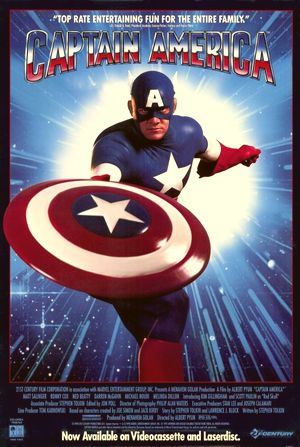
The 1990 American-Yugoslavian direct-to-video action film Captain America is the first cinematic adaptation of the character with some semblance of attention paid to the actual character. The first act plays out like a truncated version of Captain America: The First Avenger, with Cap being selected for the Super Soldier Serum, then squaring off against the Red Skull. Cap gets strapped to a rocket that he steers away from the White House and into, if I'm not mistaken, Alaska. After being frozen for about fifty years, Steve Rogers (Matt Salinger) breaks free from the ice and traipses from Alaska down through northern Canada in an attempt to find his way home. At first he does not accept that he is fifty years in the future, but this is a thematic and plot thread that predictably goes nowhere. Instead of exploring his man-outside-of-time psychology, Rogers teams up with his old girlfriend's daughter (a bit gross) and goes after the Red Skull, who is still alive and has recently kidnapped the President (Ronny Cox) because he doesn't like the President's environmental bill. Also, the Red Skull has had face reconstruction surgery since the forties so he no longer has a red skull, just an ugly face.
Captain America may engage with the iconography on the surface level, but as you can probably tell by that recap, the film isn't terribly interested in exploring why the character resonates. It probably would have been better served as a cheesy period piece, but the narrative break between WWII and present day is jarring and disappointing, especially since most of the rest of the movie involves Captain America trekking across the Canadian wilderness in his goofy suit, or sitting around in suburbia acting awfully calm for somebody who has just time traveled fifty years into the future.
The fact that the Red Skull is still around fifty years later, but has waited until now for his most dastardly plot, is also distressing from a storytelling perspective. Plus, taking away his iconic look feels like a cop out at best.
Other Reviews in this Series.
Director: Albert Pyun
Writers: Stephen Tolkin, Lawrence Block
Cast: Matt Salinger, Kim Gillingham, Ronny Cox, Ned Beatty, Scott Paulin
Runtime: 97 mins.
1990
The 1990 American-Yugoslavian direct-to-video action film Captain America is the first cinematic adaptation of the character with some semblance of attention paid to the actual character. The first act plays out like a truncated version of Captain America: The First Avenger, with Cap being selected for the Super Soldier Serum, then squaring off against the Red Skull. Cap gets strapped to a rocket that he steers away from the White House and into, if I'm not mistaken, Alaska. After being frozen for about fifty years, Steve Rogers (Matt Salinger) breaks free from the ice and traipses from Alaska down through northern Canada in an attempt to find his way home. At first he does not accept that he is fifty years in the future, but this is a thematic and plot thread that predictably goes nowhere. Instead of exploring his man-outside-of-time psychology, Rogers teams up with his old girlfriend's daughter (a bit gross) and goes after the Red Skull, who is still alive and has recently kidnapped the President (Ronny Cox) because he doesn't like the President's environmental bill. Also, the Red Skull has had face reconstruction surgery since the forties so he no longer has a red skull, just an ugly face.
Captain America may engage with the iconography on the surface level, but as you can probably tell by that recap, the film isn't terribly interested in exploring why the character resonates. It probably would have been better served as a cheesy period piece, but the narrative break between WWII and present day is jarring and disappointing, especially since most of the rest of the movie involves Captain America trekking across the Canadian wilderness in his goofy suit, or sitting around in suburbia acting awfully calm for somebody who has just time traveled fifty years into the future.
The fact that the Red Skull is still around fifty years later, but has waited until now for his most dastardly plot, is also distressing from a storytelling perspective. Plus, taking away his iconic look feels like a cop out at best.
Labels:
assumed empathy,
camp,
Captain America,
cheesy,
genre,
iconography,
Matt Salinger,
superhero,
superhero fiction
Thursday, April 14, 2016
CAPTAIN AMERICA II: DEATH TOO SOON - Camp Cap
In the weeks leading up to Marvel's next blockbuster juggernaut, Captain America: Civil War, we will be looking at every cinematic iteration of those two warring rapscallions, Captain America and Iron Man.
Other Reviews in this Series.
Director: Ivan Nagy
Writers: Wilton Schiller, Patricia Payne
Cast: Reb Brown, Connie Sellecca, Len Birman, Christopher Lee
Runtime: 83 mins.
1979
Captain America II: Death Too Soon is the 1979 sequel to the 1979 TV movie Captain America, and it is several orders of magnitude better than its predecessor. If you're in the market to watch one of these movies for camp purposes, it should undoubtedly be this one. It's not like you'll be missing anything important from the original's pointless wheel-spinning narrative.
In fact, the plot is a fair bit clearer and more straightforward. A mysterious terrorist who goes by the name General Miguel (Christopher Lee) plans to hold the entire town of Portland hostage by dropping an aging serum on their heads. Miguel is in hiding, pretending to be a prison warden at a local penitentiary. Steve Rogers (Reb Brown) must investigate a small town where something suspicious is going on, so that he might ultimately discover Miguel's location and let Captain America take care of business. Meanwhile, in an irrelevant B-plot, our favorite scientists Dr. Simon Mills (Len Birman) and Dr. Wendy Day (conspicuously replaced by Connie Sellecca--didn't this character used to be blonde??) are working on a cure for the virus. They deliver exposition ably, but fail at everything else.
The film still takes a little too long to reveal what is going on in the town, but the plot is for the most part less obtuse. This is very much to the film's advantage, because the last thing this movie should want is for us to start using our brains to figure out what is happening. Everything about the story is ridiculous, of course, but it's well within the reasonable bounds of schlock sci-fi. Steve Rogers taking time to woo a single mother and hang out at her farm with her kid is a less forgivable narrative misstep.
That being said, you can shrug that stuff off with a laugh because, unlike Captain America, Captain America II doesn't spend an ungodly amount of time on every single sequence. It sets up what it needs to, knocks it down, and awkwardly edits into the next scene. Parts of it still drag, but at least we're not watching a doofus go off motorcycle jumps for five to ten minutes at a time.
Other Reviews in this Series.
Director: Ivan Nagy
Writers: Wilton Schiller, Patricia Payne
Cast: Reb Brown, Connie Sellecca, Len Birman, Christopher Lee
Runtime: 83 mins.
1979
Captain America II: Death Too Soon is the 1979 sequel to the 1979 TV movie Captain America, and it is several orders of magnitude better than its predecessor. If you're in the market to watch one of these movies for camp purposes, it should undoubtedly be this one. It's not like you'll be missing anything important from the original's pointless wheel-spinning narrative.
In fact, the plot is a fair bit clearer and more straightforward. A mysterious terrorist who goes by the name General Miguel (Christopher Lee) plans to hold the entire town of Portland hostage by dropping an aging serum on their heads. Miguel is in hiding, pretending to be a prison warden at a local penitentiary. Steve Rogers (Reb Brown) must investigate a small town where something suspicious is going on, so that he might ultimately discover Miguel's location and let Captain America take care of business. Meanwhile, in an irrelevant B-plot, our favorite scientists Dr. Simon Mills (Len Birman) and Dr. Wendy Day (conspicuously replaced by Connie Sellecca--didn't this character used to be blonde??) are working on a cure for the virus. They deliver exposition ably, but fail at everything else.
The film still takes a little too long to reveal what is going on in the town, but the plot is for the most part less obtuse. This is very much to the film's advantage, because the last thing this movie should want is for us to start using our brains to figure out what is happening. Everything about the story is ridiculous, of course, but it's well within the reasonable bounds of schlock sci-fi. Steve Rogers taking time to woo a single mother and hang out at her farm with her kid is a less forgivable narrative misstep.
That being said, you can shrug that stuff off with a laugh because, unlike Captain America, Captain America II doesn't spend an ungodly amount of time on every single sequence. It sets up what it needs to, knocks it down, and awkwardly edits into the next scene. Parts of it still drag, but at least we're not watching a doofus go off motorcycle jumps for five to ten minutes at a time.
Labels:
Captain America,
Captain America II: Death Too Soon,
genre,
Marvel movies,
Reb Brown,
superhero,
superhero fiction
Monday, April 11, 2016
CAPTAIN AMERICA: Cap-ital Punishment
In the weeks leading up to Marvel's next blockbuster juggernaut, Captain America: Civil War, we will be looking at every cinematic iteration of those two warring rapscallions, Captain America and Iron Man.
Other Reviews in this Series.
Director: Rod Holcomb
Writers: Don Ingalls, Chester Krumholz
Cast: Reb Brown, Len Birman, Heather Menzies-Urich, Robin Mattson, Joseph Ruskin
Runtime: 97 mins.
1979
The 1979 TV Movie Captain America has a simple premise: What if Captain America's son were a selfish, imbecilic slacker? And what if we made a movie about him?
Of course, the film doesn't seem altogether aware of its own premise, as we are apparently supposed to find this man impressive and heroic. He is not. Let me lay it out for you.
Steve Rogers (Reb Brown) is a hunky behemoth who has just returned from active military service. Now that he's out, his goal in life is to drive around in his van and be lazy for the foreseeable future. He also draws. These are his sole character traits.
Other Reviews in this Series.
Director: Rod Holcomb
Writers: Don Ingalls, Chester Krumholz
Cast: Reb Brown, Len Birman, Heather Menzies-Urich, Robin Mattson, Joseph Ruskin
Runtime: 97 mins.
1979
The 1979 TV Movie Captain America has a simple premise: What if Captain America's son were a selfish, imbecilic slacker? And what if we made a movie about him?
Of course, the film doesn't seem altogether aware of its own premise, as we are apparently supposed to find this man impressive and heroic. He is not. Let me lay it out for you.
Steve Rogers (Reb Brown) is a hunky behemoth who has just returned from active military service. Now that he's out, his goal in life is to drive around in his van and be lazy for the foreseeable future. He also draws. These are his sole character traits.
Labels:
assumed empathy,
bad,
boring,
Captain America,
genre,
made for TV,
Reb Brown,
superhero,
superhero fiction
Tuesday, March 29, 2016
SPEED RACER: Gotta Go Fast
March is Women's History Month, which Post-Credit Coda will take as an opportunity for weekly reviews of films by female directors. Of all the reviews I've written in 2+ years, only four and a half of the movies have been directed by women. Women are slooooowly starting to receive better on camera roles in Hollywood, yet the lack of female directors is a continuous blight on the industry. Unskilled and inexperienced men are typically given far grander opportunities while proven, talented women are ignored. Despite the adversity, some women still manage to bring their projects to fruition. Let's hope that in the future this becomes the norm rather than the exception.
Other Reviews in this Series.
Directors: Lana and Lilly Wachowski
Writers: Lilly and Lana Wachowski
Cast: Emile Hirsch, John Goodman, Susan Sarandon, Christina Ricci, Matthew Fox, Kick Gurry, Paulie Litt, Roger Allam, Rain
Runtime: 135 mins.
2008
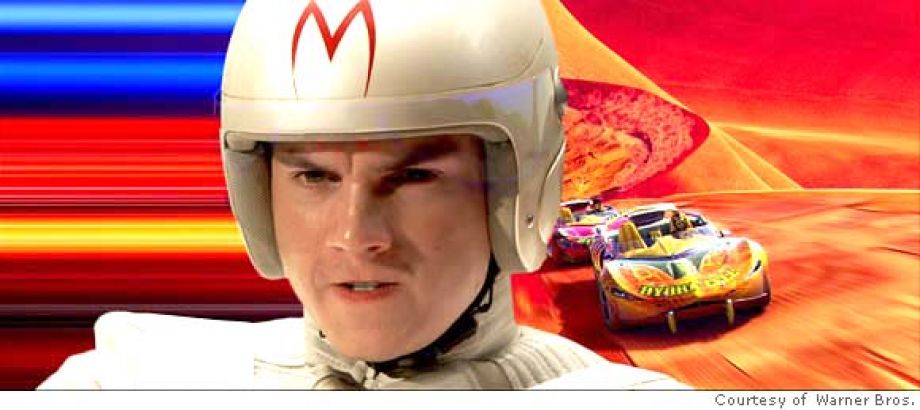
The film opens with a flash of color, then the camera creeps in on the back of a racer. We hear the sounds of revving engines and squealing tires. We see the racer's foot tapping in anticipation. Then, a match cut to a child's pencil tapping on a standardized test. This is a flashback that shows us a glimpse of Speed Racer's troubled youth. The teachers consider him a problem child because all he wants to do, all he can really focus on, is racing. The boy sits at his desk, his concentration ebbing, until the drab classroom transforms into multicolored streaks of light, the essence of speed, and the little boy is driving just like his older brother Rex.
What follows is an extended sequence of adult Speed Racer racing, intercut with inserts of his family cheering him on from the crowd, each of which zips us away into another propulsive flashback that fills out Speed's relationship with all of the main characters and contextualizes the importance of the race. Typically "propulsive flashback" is something of an oxymoron, but not here. This isn't like Deadpool's clever but pedestrian use of backstory in the midst of action. This sequence is edited, paced, and scored such that even when we have entered quiet character moments, we feel as if we have never left the race.
All of this adds up to a stunning twenty minutes of discovery and emotion, culminating in Speed racing the ghost of his dead older brother for the course record. It is the absolute perfect way to begin this film, an opening that perhaps only compares to Up with regard to sheer bang for your buck, emotional investment refined into the most efficient and efficacious package.
I knew from one minute in that Speed Racer would be a masterpiece.
Other Reviews in this Series.
Directors: Lana and Lilly Wachowski
Writers: Lilly and Lana Wachowski
Cast: Emile Hirsch, John Goodman, Susan Sarandon, Christina Ricci, Matthew Fox, Kick Gurry, Paulie Litt, Roger Allam, Rain
Runtime: 135 mins.
2008
The film opens with a flash of color, then the camera creeps in on the back of a racer. We hear the sounds of revving engines and squealing tires. We see the racer's foot tapping in anticipation. Then, a match cut to a child's pencil tapping on a standardized test. This is a flashback that shows us a glimpse of Speed Racer's troubled youth. The teachers consider him a problem child because all he wants to do, all he can really focus on, is racing. The boy sits at his desk, his concentration ebbing, until the drab classroom transforms into multicolored streaks of light, the essence of speed, and the little boy is driving just like his older brother Rex.
What follows is an extended sequence of adult Speed Racer racing, intercut with inserts of his family cheering him on from the crowd, each of which zips us away into another propulsive flashback that fills out Speed's relationship with all of the main characters and contextualizes the importance of the race. Typically "propulsive flashback" is something of an oxymoron, but not here. This isn't like Deadpool's clever but pedestrian use of backstory in the midst of action. This sequence is edited, paced, and scored such that even when we have entered quiet character moments, we feel as if we have never left the race.
All of this adds up to a stunning twenty minutes of discovery and emotion, culminating in Speed racing the ghost of his dead older brother for the course record. It is the absolute perfect way to begin this film, an opening that perhaps only compares to Up with regard to sheer bang for your buck, emotional investment refined into the most efficient and efficacious package.
I knew from one minute in that Speed Racer would be a masterpiece.
Labels:
animated,
CGI,
Emile Hirsch,
genre,
innovative,
John Goodman,
Speed Racer,
the Wachowski sisters,
Women's History Month
Tuesday, March 15, 2016
A GIRL WALKS HOME ALONE AT NIGHT: Every Good Boy Does Fine
March is Women's History Month, which Post-Credit Coda will take as an opportunity for weekly reviews of films by female directors. Of all the reviews I've written in 2+ years, only four and a half of the movies have been directed by women. Women are slooooowly starting to receive better on camera roles in Hollywood, yet the lack of female directors is a continuous blight on the industry. Unskilled and inexperienced men are typically given far grander opportunities while proven, talented women are ignored. Despite the adversity, some women still manage to bring their projects to fruition. Let's hope that in the future this becomes the norm rather than the exception.
Other Reviews in this Series.
Director: Ana Lily Amirpour
Writer: Ana Lily Amirpour
Cast: Sheila Vand, Arash Marandi, Marshall Manesh, Mozhan Marno, Dominic Rains
Runtime: 101 mins.
2014
A Girl Walks Home Alone at Night has, first and foremost, a killer title. Amirpour could have easily gone with something bluntly evocative like The Vampire, but instead she went the route of a flashy eight syllable name that makes this movie something of a commitment to bring up in casual conversation. Marketers hate that sort of thing, but as this article about naming conventions suggests, we wouldn't want Eternal Sunshine of the Spotless Mind to be called The Dream, would we?
The title also perfectly plays upon our preconceived notions. When presented with the image of a girl walking home alone at night, especially in the context of a horror movie, we assume she will be the victim of some perverse attack. Every signifier in that string of words is meant to evoke vulnerability. The joke's on us, though. In this movie the girl is the aggressor, the shadowy figure out for blood.
Other Reviews in this Series.
Director: Ana Lily Amirpour
Writer: Ana Lily Amirpour
Cast: Sheila Vand, Arash Marandi, Marshall Manesh, Mozhan Marno, Dominic Rains
Runtime: 101 mins.
2014
A Girl Walks Home Alone at Night has, first and foremost, a killer title. Amirpour could have easily gone with something bluntly evocative like The Vampire, but instead she went the route of a flashy eight syllable name that makes this movie something of a commitment to bring up in casual conversation. Marketers hate that sort of thing, but as this article about naming conventions suggests, we wouldn't want Eternal Sunshine of the Spotless Mind to be called The Dream, would we?
The title also perfectly plays upon our preconceived notions. When presented with the image of a girl walking home alone at night, especially in the context of a horror movie, we assume she will be the victim of some perverse attack. Every signifier in that string of words is meant to evoke vulnerability. The joke's on us, though. In this movie the girl is the aggressor, the shadowy figure out for blood.
Tuesday, March 8, 2016
THE HITCH-HIKER: Thumbs Up
March is Women's History Month, which Post-Credit Coda will take as an opportunity for weekly reviews of films by female directors. Of all the reviews I've written in 2+ years, only four and a half of the movies have been directed by women. Women are slooooowly starting to receive better on camera roles in Hollywood, yet the lack of female directors is a continuous blight on the industry. Unskilled and inexperienced men are typically given far grander opportunities while proven, talented women are ignored. Despite the adversity, some women still manage to bring their projects to fruition. Let's hope that in the future this becomes the norm rather than the exception.
Other Reviews in this Series.
Director: Ida Lupino
Writers: Collier Young, Ida Lupino, Robert L. Joseph
Cast: Frank Lovejoy, Edmond O'Brien, William Talman
Runtime: 70 mins.
1953
When Ida Lupino was a child, her father told her, "You're a strange, interesting girl. Your mother and I, to be honest with you, prayed... we would have a son. I think you're going to end up doing what my son would have done. You will write, direct, and produce." This would turn out to be prescient, or perhaps something of a self-fulfilling prophecy, as Lupino would grow up to become an actress who was dissatisfied with the limits of a Hollywood acting career. She was frequently suspended by Warner Bros. for not making the movies they wanted her to make, and during that time she familiarized herself with the technical processes of filmmaking. In her words, while she was sitting around being bored on set, "someone else seemed to be doing all the interesting work."
Lupino transitioned into producing, writing, and directing with her own production company, an unheard of feat for a woman in Hollywood during that era. In the earliest years of film female filmmakers were fairly common, but by the '40s and '50s Hollywood had become a boys' club, with women primarily relegated to acting and editing. Seventy years later and women are still by and large unwelcome in the director's chair, which makes Lupino's achievements all the more extraordinary. Not only was she prolific, but she was uncompromising in a way that was unpalatable to the gender roles of the time, yet she still managed to toe the line enough to keep finding opportunities to make her art. She was interested in creating strong female characters, "[not] women who have masculine qualities about them, but [a role] that has intestinal fortitude, some guts to it." Again, seventy years later and this is still a concept that big budget writers and studio execs cannot wrap their minds around, instead construing the term Strong Female Character as a hot woman who can punch things hard. Lupino accessed the power of the feminine in a masculine-dominated world, preferring to be called "mother" while on set, which she considered emblematic of the act of creation.
All this is fascinating to keep in mind when looking at The Hitch-Hiker, Lupino's sixth (though only fourth credited) directorial effort. The film follows two fishing buddies who pick up a dangerous hitchhiker, the psychopathic killer Emmett Myers (William Talman). The film chronicles their captivity, in which they are forced at gunpoint to aid Myers' escape across Baja California. Snippets of the police pursuit are sprinkled throughout, but for the most part we are trapped in pressure cooker situation after situation, in which Myers abuses his captives both physically and psychologically. He considers them weak, you see, too dependent upon the love and support of others, whereas he is strong because he's always made his own way and never taken any help from anybody.
Other Reviews in this Series.
Director: Ida Lupino
Writers: Collier Young, Ida Lupino, Robert L. Joseph
Cast: Frank Lovejoy, Edmond O'Brien, William Talman
Runtime: 70 mins.
1953
When Ida Lupino was a child, her father told her, "You're a strange, interesting girl. Your mother and I, to be honest with you, prayed... we would have a son. I think you're going to end up doing what my son would have done. You will write, direct, and produce." This would turn out to be prescient, or perhaps something of a self-fulfilling prophecy, as Lupino would grow up to become an actress who was dissatisfied with the limits of a Hollywood acting career. She was frequently suspended by Warner Bros. for not making the movies they wanted her to make, and during that time she familiarized herself with the technical processes of filmmaking. In her words, while she was sitting around being bored on set, "someone else seemed to be doing all the interesting work."
Lupino transitioned into producing, writing, and directing with her own production company, an unheard of feat for a woman in Hollywood during that era. In the earliest years of film female filmmakers were fairly common, but by the '40s and '50s Hollywood had become a boys' club, with women primarily relegated to acting and editing. Seventy years later and women are still by and large unwelcome in the director's chair, which makes Lupino's achievements all the more extraordinary. Not only was she prolific, but she was uncompromising in a way that was unpalatable to the gender roles of the time, yet she still managed to toe the line enough to keep finding opportunities to make her art. She was interested in creating strong female characters, "[not] women who have masculine qualities about them, but [a role] that has intestinal fortitude, some guts to it." Again, seventy years later and this is still a concept that big budget writers and studio execs cannot wrap their minds around, instead construing the term Strong Female Character as a hot woman who can punch things hard. Lupino accessed the power of the feminine in a masculine-dominated world, preferring to be called "mother" while on set, which she considered emblematic of the act of creation.
All this is fascinating to keep in mind when looking at The Hitch-Hiker, Lupino's sixth (though only fourth credited) directorial effort. The film follows two fishing buddies who pick up a dangerous hitchhiker, the psychopathic killer Emmett Myers (William Talman). The film chronicles their captivity, in which they are forced at gunpoint to aid Myers' escape across Baja California. Snippets of the police pursuit are sprinkled throughout, but for the most part we are trapped in pressure cooker situation after situation, in which Myers abuses his captives both physically and psychologically. He considers them weak, you see, too dependent upon the love and support of others, whereas he is strong because he's always made his own way and never taken any help from anybody.
Labels:
Duel,
female directors,
film noir,
genre,
Ida Lupino,
The Hitch-Hiker,
Women's History Month
Thursday, February 25, 2016
THE WITCH: Toil and Trouble
Director: Robert Eggers
Writer: Robert Eggers
Cast: Anya Taylor-Joy, Ralph Ineson, Kate Dickie, Harvey Scrimshaw, Ellie Grainger, Lucas Dawson
Runtime: 92 mins
2016
I saw The Witch with a mostly full crowd. They talked, texted, and laughed through it. At the end the lights came up and people started grumbling.
"I want my money back."
"I couldn't even understand what they were saying."
"That was one of the worst movies I've ever seen."
Meanwhile my friends and I sat transfixed and slowly recovering from a soulwrenching cinematic experience. We remained shaken through dinner, and when I got home I felt uneasy turning out the lights for bed.
How could we have possibly had such a disparate experience from all the people around us?
Labels:
Anya Taylor-Joy,
genre,
horror,
period piece,
Robert Eggers,
The Witch
Monday, February 22, 2016
DEADPOOL: Funny or Die
Director: Tim Miller
Writers: Rhett Reese, Paul Wernick
Cast: Ryan Reynolds, Morena Baccarin, Ed Skrein, T.J. Miller, Brianna Hildebrand, Stefan Kapicic
Runtime: 108 mins.
2016
I have mixed feelings about Deadpool. The character immediately gripped me when I first discovered him in high school. As a friend recently put it, "He defeated a bad guy with a thought bubble. That's the greatest."
The structure of my personality has always been particularly susceptible to metafiction. "Metafiction" is shorthand for any work of art that is within the work of art aware of itself as a work of art. Basically, it's when the characters are allowed to talk back to the reader. The way form can dominate content in metanarrative has great appeal to folks with a structure-heavy mindset. Deadpool was one of my first exposures to blatant metafiction, and it was revelatory. The character was actively recognizing the formal context in which he was placed! He was bringing subtext to the level of text! He was making jokes about the audience's relation to fictionalized characters! It struck me as smart and very, very funny.
After digging into metafiction for my college English thesis, I've come to realize that the most important part of metafiction is not how clever or creative it is, but how well it is able to ground itself in real emotional truth. Vulnerability is the key to any meaningful narrative, and metafiction more than other genres can easily be too clever for its own good. By constantly referencing itself, a story can get caught up in irony to the point that it ceases to say anything more than "Look at how smart I am!"
Please.
Please look at how smart I am.
Labels:
action,
blockbuster,
Deadpool,
genre,
metafiction,
R rated,
Ryan Reynolds,
superhero,
Tim Miller
Saturday, January 9, 2016
THE HATEFUL EIGHT: America's Secret Sin
Director: Quentin Tarantino
Writer: Quentin Tarantino
Cast: Samuel L. Jackson, Kurt Russell, Jennifer Jason Leigh, Walton Goggins, Tim Roth, Michael Madsen, Demian Bichir, Bruce Dern, James Parks, Channing Tatum
Runtime: 187 mins.
2015
I take pains to keep my reviews here as substantive as possible while providing the fewest number of plot and story details I can get away with. The lowest form of film criticism is by-the-numbers plot recap. I admire film reviews that can give me an idea of the movie while skirting any information that might influence my experience of the story.
However, I don't feel like I can give a proper review of The Hateful Eight, one of Tarantino's more controversial works, without digging into heavy spoilers. So I'm going to split this post into Spoiler and Non-Spoiler sections.
Labels:
allegory,
apocalyptic,
character analysis,
close reading,
gender,
genre,
horror,
parable,
Quentin Tarantino,
race,
The Hateful Eight,
western
Wednesday, December 2, 2015
MOCKINGJAY - PART 2: Capitol Punishment
Director: Francis Lawrence
Writers: Peter Craig, Danny Strong
Cast: Jennifer Lawrence, Josh Hutcherson, Liam Hemsworth, Julianne Moore, Woody Harrelson, Donald Sutherland, Philip Seymour Hoffman, Willow Shields, Sam Claflin, Elizabeth Banks, Mahershala Ali, Jena Malone, Jeffrey Wright, Stanley Tucci, Patina Miller, Gwendoline Christie
Runtime: 137 mins.
2015
The real bummer about Mockingjay - Part 2 is how serviceable it is. The first Hunger Games movie had just enough problems that it left me cold, so I was shocked when Catching Fire ended up being one of my favorite movies of 2013. That film is jampacked with memorable characters who are each given a host of personality traits and political affiliations. Then along came Mockingjay - Part 1, a movie which retained all the memorable characters, but mostly had them walk around and talk to each other for two hours. If you can choke your way through my audio review of that movie, you'll hear that I found the actionlessness of Part 1 to be mostly enjoyable. Scenes meandered here and there, but the characters felt lived in, and the movie did some really interesting work with propaganda and symbolism. At any rate, the dullness of Part 1 was supposed to be a necessary byproduct of it being the first of a two-parter.
Now, a year later, we have the final entry, a movie that came with the promise of providing a wham-bang conclusion to one of the most successful movie franchises of our generation, and instead we get... serviceable. This time plenty of stuff happens, to be sure. It's just that nobody seems invested in doing these things. Between Francis Lawrence's workmanlike directing, the screenwriters' straightforward adaptation, and the lead actors' adequate performances, Mockingjay - Part 2 feels like a movie franchise that knows it has ended up one movie longer than it should have been. The franchise has outgrown itself.
Labels:
action,
assumed empathy,
dystopia,
Francis Lawrence,
genre,
Hunger Games,
Jennifer Lawrence,
Mockingjay
Saturday, October 31, 2015
ZOMBEAVERS: Bucking Trends
Director: Jordan Rubin
Writers: Jordan Rubin, Al Kaplan, Jon Kaplan
Cast: Rachel Melvin, Courtney Palm, Lexi Atkins, Hutch Dano, Jake Weary, Peter Gilroy
Runtime: 85 mins.
2014
Watching bad horror requires mental gymnastics no lesser than those required for art house films. Part of that has to do with the violent reductionism that comes with the term "bad horror." It can mean all sorts of things: The Troll 2 idiosyncratic acid dream kind of bad. The House at the End of the Street dull slog kind of bad. The Cabin in the Woods only pretending at being bad. The Rubber self-consciousness that elevates the filmmaker above the audience kind of bad. Then there's something like James Gunn's directorial debut, Slither, which has much more in common with Zombeavers than the rest. This list of movies shares little beyond the designation of "horror," each featuring distinctive tones, themes, goals, and levels of irony. "Bad horror" lumps together movies that have scant business being in the same conversation, and it can lead to two people talking past each other. "Oh yeah, I heard that movie was awful," could be said with a disdainful scoff, or with barely contained glee--and it could be received in many more diverse ways.
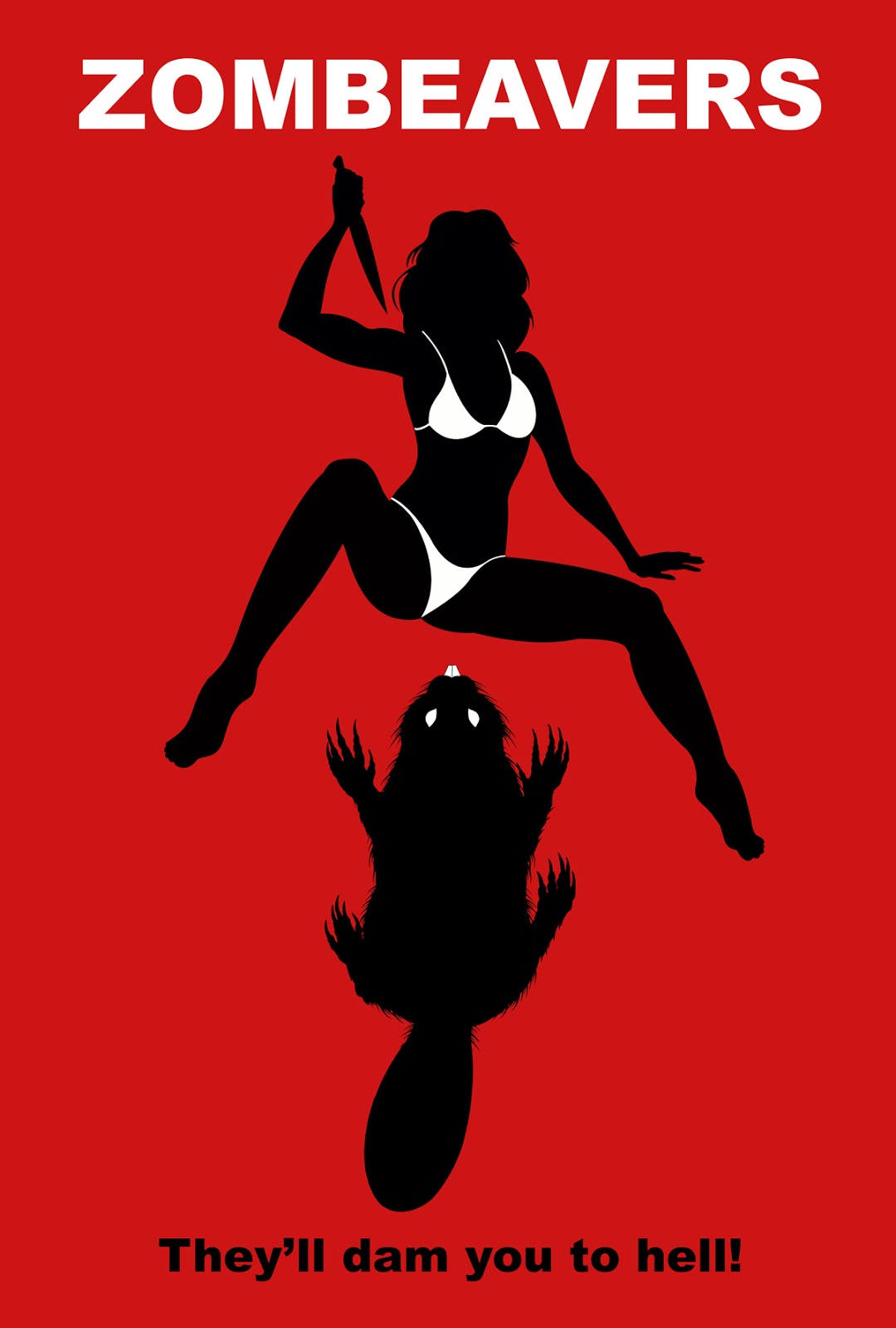
It all comes down to meeting a movie on its own terms. Zombeavers first splashed into the public's consciousness with a trailer that went viral and shot up to 1,000,000+ views in a week's time. In the wake of this surprise publicity, folks all across the internet were heralding the movie as the next Sharknado. Now, I like Sharknado. It's fun, but the pervasive this-is-soooo-awful-let's-all-laugh-at-how-awful-this-is attitude can get grating after a while. The sly winking is palpable. I'm an advocate of self-awareness, but there's something disingenuous about setting out to make a bad movie. It can seem like the creators just want a backdoor excuse to wave away any problems the final product might have. Merely advertising It's Supposed to Be Bad! does not forgive all ills.
Labels:
Al Kaplan,
genre,
Halloween,
horror,
horror comedy,
Jon Kaplan,
Jordan Rubin,
special effects,
Zombeavers
Friday, October 16, 2015
THE MARTIAN: Look at Those Cavemen Go
Director: Ridley Scott
Writer: Drew Goddard
Cast: Matt Damon, Jessica Chastain, Chiwetel Ejiofor, Jeff Daniels, Michael Pena, Kristen Wiig, Sean Bean, Kate Mara, Sebastian Stan, Aksel Hennie, Benedict Wong, Mackenzie Davis, Donald Glover
Runtime: 144 mins.
2015
The Martian doesn't have the imagination of Insterstellar. It doesn't have the visceral pleasures of Gravity. It doesn't have the depth of philosophy or breadth of scope that 2001: A Space Odyssey boasts. But it does have one thing: Sam Rockwell.
No wait, I'm thinking of Moon.
To figure out what The Martian has, I've found myself thinking a lot about what it doesn't. The movie follows the plight of Mark Watney (Matt Damon), an astronaut who is stranded and presumed dead on a routine mission to Mars. He must find a way to survive in increasingly unlikely circumstances, while also figuring out how to get NASA to send a rescue mission. On the other end of those 54.6 million kilometers, every facet of NASA is busily working on the logistics, ethics, and publicity angles of such a rescue mission. But mostly the logistics, because everyone in this movie is basically a good person.
Labels:
event movie,
genre,
humanity,
Matt Damon,
Ridley Scott,
The Martian
Monday, October 12, 2015
WAR OF THE WORLDS: Tripod Shuffle
Every other day leading up to the release of his new movie Bridge of Spies, we will be dissecting a film in Steven Spielberg's oeuvre. I've picked ten movies spanning the length of Spielberg's career, five of which I have seen and five of which I haven't. This week War of the Worlds batters us with the frailty of humanity.
Other Reviews in this Series: Duel, Close Encounters of the Third Kind, 1941, Empire of the Sun, Amistad, A.I. Artificial Intelligence, Catch Me If You Can, Munich, Lincoln
Other Spielberg Reviews: Jaws, Jurassic Park, The Lost World, Bridge of Spies
Director: Steven Spielberg
Writers: Josh Friedman, David Koepp
Cast: Tom Cruise, Dakota Fanning, Justin Chatwin
Runtime: 116 mins.
2005
The coolest thing about War of the Worlds is that it's bleak as hell. Until this point Spielberg's history of representing extraterrestrials had ranged from awe-inspiring (Close Encounters of the Third Kind) to charming (ET), but with War of the Worlds old kid-friendly spielberg leans heavy into despair. The movie is punishing, as if Cormac McCarthy decided to apply himself to B-movie sci-fi. The actual scribes were Josh Friedman and David Koepp, with some key input from Spielberg. They craft a narrative that starts out mean and gets meaner, until the saccharine turn at the very end of the movie that many critics rightly thumbed their collective noses at.
Other Reviews in this Series: Duel, Close Encounters of the Third Kind, 1941, Empire of the Sun, Amistad, A.I. Artificial Intelligence, Catch Me If You Can, Munich, Lincoln
Other Spielberg Reviews: Jaws, Jurassic Park, The Lost World, Bridge of Spies
Director: Steven Spielberg
Writers: Josh Friedman, David Koepp
Cast: Tom Cruise, Dakota Fanning, Justin Chatwin
Runtime: 116 mins.
2005
The coolest thing about War of the Worlds is that it's bleak as hell. Until this point Spielberg's history of representing extraterrestrials had ranged from awe-inspiring (Close Encounters of the Third Kind) to charming (ET), but with War of the Worlds old kid-friendly spielberg leans heavy into despair. The movie is punishing, as if Cormac McCarthy decided to apply himself to B-movie sci-fi. The actual scribes were Josh Friedman and David Koepp, with some key input from Spielberg. They craft a narrative that starts out mean and gets meaner, until the saccharine turn at the very end of the movie that many critics rightly thumbed their collective noses at.
The burden of modernizing the nineteenth century science fiction novel rested primarily on Koepp's shoulders, and he makes all the right choices. The narrative may be divorced from the power it held as a radio play, but there are a new set of perverse fascinations at its heart, as the screenplay sometimes awkwardly but mostly gracefully gestures to terrorism and the post-9/11 American frame of mind. Koepp claims to have avoided such associations as best he could, while Spielberg more readily admits to being inspired by them.
Labels:
aliens,
apocalyptic,
genre,
series,
Steven Spielberg,
Tom Cruise,
War of the Worlds
Thursday, October 8, 2015
A.I.: Auteur Intelligence
Every other day leading up to the release of his new movie Bridge of Spies, we will be dissecting a film in Steven Spielberg's oeuvre. I've picked ten movies spanning the length of Spielberg's career, five of which I have seen and five of which I haven't. A.I. Artificial Intelligence could be the most interesting movie of Spielberg's career, though it is far from the best.
Other Reviews in this Series: Duel, Close Encounters of the Third Kind, 1941, Empire of the Sun, Amistad, Catch Me If You Can, War of the Worlds, Munich, Lincoln
Other Spielberg Reviews: Jaws, Jurassic Park, The Lost World, Bridge of Spies
(If you haven't already, check out my new archive in the corner ---->)
Director: Steven Spielberg
Writer: Steven Spielberg, Ian Watson
Cast: Haley Joel Osment, Jude Law, Frances O'Connor, William Hurt, Sam Robards, Jake Thomas
Runtime: 146 mins.
2001
In the 70's legendary director Stanley Kubrick began developing a story about a childlike artificial intelligence who was programmed to display genuine affection. This project remained on the perpetual backburner, as Kubrick purportedly believed the main character would need to be created by special effects, and effects had not yet reached the necessary level of quality.* Decades passed, writers and producers came and went, and in the 90's Kubrick finally decided to hand the movie over to his friend and collaborator, Steven Spielberg. He simply decided that the film's content fit Spielberg's sensibilities better than his own. Years later Spielberg began work in earnest on the project, but Kubrick died in 1999 and was not able to see the fruits of his passionate labor.
*It turns out all Kubrick needed was a certifiable genius child actor, and Haley Joel Osment 100% fits that bill. His work as David contains an incredible amount of nuance.
Other Reviews in this Series: Duel, Close Encounters of the Third Kind, 1941, Empire of the Sun, Amistad, Catch Me If You Can, War of the Worlds, Munich, Lincoln
Other Spielberg Reviews: Jaws, Jurassic Park, The Lost World, Bridge of Spies
(If you haven't already, check out my new archive in the corner ---->)
Director: Steven Spielberg
Writer: Steven Spielberg, Ian Watson
Cast: Haley Joel Osment, Jude Law, Frances O'Connor, William Hurt, Sam Robards, Jake Thomas
Runtime: 146 mins.
2001
In the 70's legendary director Stanley Kubrick began developing a story about a childlike artificial intelligence who was programmed to display genuine affection. This project remained on the perpetual backburner, as Kubrick purportedly believed the main character would need to be created by special effects, and effects had not yet reached the necessary level of quality.* Decades passed, writers and producers came and went, and in the 90's Kubrick finally decided to hand the movie over to his friend and collaborator, Steven Spielberg. He simply decided that the film's content fit Spielberg's sensibilities better than his own. Years later Spielberg began work in earnest on the project, but Kubrick died in 1999 and was not able to see the fruits of his passionate labor.
*It turns out all Kubrick needed was a certifiable genius child actor, and Haley Joel Osment 100% fits that bill. His work as David contains an incredible amount of nuance.
Labels:
auteur theory,
genre,
Haley Joel Osment,
interesting,
reflections,
sci-fi,
series,
Stanley Kubrick,
Steven Spielberg
Thursday, October 1, 2015
1941: Spielberg's Flop
Every other day leading up to the release of his new movie Bridge of Spies, we will be dissecting a film in Steven Spielberg's oeuvre. I've picked ten movies spanning the length of Spielberg's career, five of which I have seen and five of which I haven't. Here we examine 1941, that rarest of rarities: an outright bad film by Steven Spielberg.
Other Reviews in this Series: Duel, Close Encounters of the Third Kind, Empire of the Sun, Amistad, A.I. Artificial Intelligence, Catch Me If You Can, War of the Worlds, Munich, Lincoln
Other Spielberg Reviews: Jaws, Jurassic Park, The Lost World, Bridge of Spies
(If you haven't already, check out my new archive in the corner ---->)
Disclaimer: I watched the extended director's cut, so take any complaints about the length of this film with a grain of salt.
Director: Steven Spielberg
Writers: Robert Zemeckis, Bob Gale, John Milius
Cast: Bobby Di Cicco, Dan Aykroyd, Ned Beatty, John Belushi, Lorraine Gary, Murray Hamilton, Christopher Lee, Tim Matheson, Toshiro Mifune, Warren Oates, Robert Stack, Treat Williams, Nancy Allen, John Candy, Eddie Deezen, Perry Lang, Frank McRae, Slim Pickens
Runtime: 118 mins. (directors cut: 145 mins)
1979
1941 is great, but not funny.
-Stanley Kubrick
Humor is a magical elixir. It's like practicing alchemy except sometimes it actually works. Professional improvisers, comedians, Sunday comics writers*, and comic filmmakers have dedicated whole careers to seeking out that elixir, and trying to capture its magic consistently. So what is it that makes a movie funny?
*maybe not
In the wake of the massive success of Jaws and Close Encounters of the Third Kind, Spielberg decided the answer is excess. 1941 is a movie about California in the fallout following the attack on Pearl Harbor. Everybody is convinced that the Japanese are going to invade Californian soil, and the attack could strike at any moment. The movie is a wide-ranging survey of mostly military characters who mostly react with panic or bravado until their paths mostly cross in one of several of the movies climaxes. Everything in 1941 is built for bombast. The special effects are spectacular, the gags are enormous (often involving heavy machinery of war), and the cast boasts a great many of the comedic stars of the '70s. It's a cavalcade of tomfoolery.
It's also overlong, oversaturated, and not very funny.
Other Reviews in this Series: Duel, Close Encounters of the Third Kind, Empire of the Sun, Amistad, A.I. Artificial Intelligence, Catch Me If You Can, War of the Worlds, Munich, Lincoln
Other Spielberg Reviews: Jaws, Jurassic Park, The Lost World, Bridge of Spies
(If you haven't already, check out my new archive in the corner ---->)
Disclaimer: I watched the extended director's cut, so take any complaints about the length of this film with a grain of salt.
Director: Steven Spielberg
Writers: Robert Zemeckis, Bob Gale, John Milius
Cast: Bobby Di Cicco, Dan Aykroyd, Ned Beatty, John Belushi, Lorraine Gary, Murray Hamilton, Christopher Lee, Tim Matheson, Toshiro Mifune, Warren Oates, Robert Stack, Treat Williams, Nancy Allen, John Candy, Eddie Deezen, Perry Lang, Frank McRae, Slim Pickens
Runtime: 118 mins. (directors cut: 145 mins)
1979
1941 is great, but not funny.
-Stanley Kubrick
Humor is a magical elixir. It's like practicing alchemy except sometimes it actually works. Professional improvisers, comedians, Sunday comics writers*, and comic filmmakers have dedicated whole careers to seeking out that elixir, and trying to capture its magic consistently. So what is it that makes a movie funny?
*maybe not
In the wake of the massive success of Jaws and Close Encounters of the Third Kind, Spielberg decided the answer is excess. 1941 is a movie about California in the fallout following the attack on Pearl Harbor. Everybody is convinced that the Japanese are going to invade Californian soil, and the attack could strike at any moment. The movie is a wide-ranging survey of mostly military characters who mostly react with panic or bravado until their paths mostly cross in one of several of the movies climaxes. Everything in 1941 is built for bombast. The special effects are spectacular, the gags are enormous (often involving heavy machinery of war), and the cast boasts a great many of the comedic stars of the '70s. It's a cavalcade of tomfoolery.
It's also overlong, oversaturated, and not very funny.
Tuesday, September 29, 2015
CLOSE ENCOUNTERS OF THE THIRD KIND: I Want to Believe
Every other day leading up to the release of his new movie Bridge of Spies, we will be dissecting a film in Steven Spielberg's oeuvre. I've picked ten movies spanning the length of Spielberg's career, five of which I have seen and five of which I haven't. Today's film is Close Encounters of the Third Kind, young Spielberg's alien encounter passion project.
Other Reviews in this Series: Duel, 1941, Empire of the Sun, Amistad, A.I. Artificial Intelligence, Catch Me If You Can, War of the Worlds, Munich, Lincoln
Other Spielberg Reviews: Jaws, Jurassic Park, The Lost World, Bridge of Spies
(If you haven't already, check out my new archive in the corner ---->)
Director: Steven Spielberg
Writer: Steven Spielberg
Cast: Richard Dreyfuss, Melinda Dillon, Francois Truffaut, Teri Garr, Bob Balaban
Runtime: 137 mins.
1977
Close Encounters of the Third Kind is a movie about aliens visiting Earth and making their first (official) contact. The entire film unravels like the first act of an alien invasion movie blown up, drawn out, and made resonant in its own right.* We see the bizarre effects of the impending alien contact on all sorts of people, only a handful of which are main characters. The most central, most explored, and most interesting human is Roy Neary (Richard Dreyfuss), who encounters a UFO on a lonely road at night, and cannot stop thinking about it. His obsession morphs into something strange and uncontrollable, and he alienates his family in the process of trying to figure out what it is that pulls him so.
*I hesitate to make this comparison, but this movie operates much like M. Night Shyamalan's Unbreakable in the sense that that film is the first act of a superhero origin story blown up, drawn out, and thus fashioned into a spiritual journey. We forget, but once upon a time Shyamalan was heralded as the new Spielberg. A few years ago the new new Spielberg was supposed to be J. J. Abrams. I think it's a testament to Spielberg's singularity that we clearly have not yet found his heir to the blockbuster throne.
I've seen Close Encounters of the Third Kind twice now, and I still have no idea exactly how I should think about it. Part of that must be that the film thematically denies this brand of dissection, imploring us, "Don't think about it: just go." It's a film about a religious conversion, among other things.
Part of it might be that this is the truest, most essential Spielberg film. That's a bit of a paradox, as so much of Close Encounters is antithetical to the sort of blockbuster that Spielberg invented. There's no strong, clear narrative arc. The protagonist isn't easily sympathetic--in fact he's kind of despicable. There aren't any explosions or fights. There isn't much of any conflict whatsoever. Nor is it akin to Spielberg's later dramatic fare, with large sweeping narratives and big historical personalities. This film is an unfocused story of everymen and nobodies. Despite all that, the one major constant of all of Spielberg's filmography, a trend that Close Encounters doubles down on, is a profound sense of awestruck wonder. That most Spielbergian of cinematic tricks is purest in Close Encounters, which is not coincidentally the only movie in all of Spielberg's career that he both wrote and directed.* Spielberg is the anti-Nolan for this reason: Nolan demands you apply your intellect to his puzzle box narratives, and rewards you for doing so. Spielberg doesn't care about any of that; if anything, Spielberg demands that you abandon your sense of logic and go along for the ride. Wonder by its nature defies the critical gaze, so maybe that's where I hit the roadblock.
*Poltergeist controversy notwithstanding. (The rumor is that in addition to writing the film, Spielberg ghost directed it.)
Or maybe it's just that Close Encounters is the sort of movie that demands to be revisited every five years or so, and is different every time. I read an article about the film recently, and the comment section was radically split between people who loved the ending (spoiler alert I guess?), whereas a large contingent found it unbelievable and/or morally reprehensible that Roy Neary decides to leave his earthly family behind and go off spacetrotting with the extraterrestrials. Personally, I love the choice. I think it's a perfect button on a movie about the inexplicable pull of the unknown. But then again, I'm a young whippersnapper who doesn't have a family of my own. Spielberg himself has admitted that, after having children, he feels like he screwed up that ending. Either way, I'm glad we got the movie we got. The ending of Close Encounters spits in the face of typical mainstream movie catharsis, and that's a big part of why it's so damned interesting.
Close Encounters is Spielberg's first movie after the massive breakthrough hit of Jaws, and it feels like he still has something to prove. The main character's arc could be read as a religious narrative of course, but it could just as soon be read as the story of the intense and uncanny pull that cinema exercised over young Spielberg's mind. That being said, the whole film sort of washes over you, like a bath in a baptismal font. Maybe it's the lack of conflict, or the deliberate pacing, but all of Close Encounters feels very much like a dream: I only recently watched it, yet I'm having a hard time remembering everything that happened, instead returning again and again to the key moments that have been emblazoned upon my memory. The abduction of the child. The inspired destruction of the suburban home. The musical conversation with the alien mothership. These strong images remain when everything else floats away.
I don't care so much about any of the other characters, but I can't stop thinking about Roy Neary's arc. This certainly means that Dreyfuss did an excellent job. His performance is engaging without being ingratiating, and subtle without being workmanlike. He's not lovable. He's not a piece of crap. He's just a person who feels the need to build a mashed potato mountain.
Special credit goes to the visual effects and, in particular, the lighting design. Apparently Spielberg did a lot of the effects concepts himself, another indicator that this was his labor of love. The visuals fit perfectly with the tone of the movie, and sometimes may look a bit shabby, but feel more real than 95% of effects driven movies. And the lighting is absolutely brilliant. The major thing I remembered from seeing Close Encounters years ago was the blaring orange light that shone through the door during the abduction scene, a scene that is a master class of building tension and the sole point in the movie where the aliens read as overtly sinister. Throughout the movie, the interplay of unnatural light and sound (or lack thereof) works beautifully to establish the uncanny without forcing tension.
It feels weird to rate Close Encounters. It's not one of my favorites, but I think it might be a masterpiece, and I appreciate the hell out of it. It's just one of those films that unveils the ultimate bankruptcy of a numeric rating scale for works of art.
4 / 5 BLOBS
Other Reviews in this Series: Duel, 1941, Empire of the Sun, Amistad, A.I. Artificial Intelligence, Catch Me If You Can, War of the Worlds, Munich, Lincoln
Other Spielberg Reviews: Jaws, Jurassic Park, The Lost World, Bridge of Spies
(If you haven't already, check out my new archive in the corner ---->)
Director: Steven Spielberg
Writer: Steven Spielberg
Cast: Richard Dreyfuss, Melinda Dillon, Francois Truffaut, Teri Garr, Bob Balaban
Runtime: 137 mins.
1977
Close Encounters of the Third Kind is a movie about aliens visiting Earth and making their first (official) contact. The entire film unravels like the first act of an alien invasion movie blown up, drawn out, and made resonant in its own right.* We see the bizarre effects of the impending alien contact on all sorts of people, only a handful of which are main characters. The most central, most explored, and most interesting human is Roy Neary (Richard Dreyfuss), who encounters a UFO on a lonely road at night, and cannot stop thinking about it. His obsession morphs into something strange and uncontrollable, and he alienates his family in the process of trying to figure out what it is that pulls him so.
*I hesitate to make this comparison, but this movie operates much like M. Night Shyamalan's Unbreakable in the sense that that film is the first act of a superhero origin story blown up, drawn out, and thus fashioned into a spiritual journey. We forget, but once upon a time Shyamalan was heralded as the new Spielberg. A few years ago the new new Spielberg was supposed to be J. J. Abrams. I think it's a testament to Spielberg's singularity that we clearly have not yet found his heir to the blockbuster throne.
I've seen Close Encounters of the Third Kind twice now, and I still have no idea exactly how I should think about it. Part of that must be that the film thematically denies this brand of dissection, imploring us, "Don't think about it: just go." It's a film about a religious conversion, among other things.
Part of it might be that this is the truest, most essential Spielberg film. That's a bit of a paradox, as so much of Close Encounters is antithetical to the sort of blockbuster that Spielberg invented. There's no strong, clear narrative arc. The protagonist isn't easily sympathetic--in fact he's kind of despicable. There aren't any explosions or fights. There isn't much of any conflict whatsoever. Nor is it akin to Spielberg's later dramatic fare, with large sweeping narratives and big historical personalities. This film is an unfocused story of everymen and nobodies. Despite all that, the one major constant of all of Spielberg's filmography, a trend that Close Encounters doubles down on, is a profound sense of awestruck wonder. That most Spielbergian of cinematic tricks is purest in Close Encounters, which is not coincidentally the only movie in all of Spielberg's career that he both wrote and directed.* Spielberg is the anti-Nolan for this reason: Nolan demands you apply your intellect to his puzzle box narratives, and rewards you for doing so. Spielberg doesn't care about any of that; if anything, Spielberg demands that you abandon your sense of logic and go along for the ride. Wonder by its nature defies the critical gaze, so maybe that's where I hit the roadblock.
*Poltergeist controversy notwithstanding. (The rumor is that in addition to writing the film, Spielberg ghost directed it.)
Or maybe it's just that Close Encounters is the sort of movie that demands to be revisited every five years or so, and is different every time. I read an article about the film recently, and the comment section was radically split between people who loved the ending (spoiler alert I guess?), whereas a large contingent found it unbelievable and/or morally reprehensible that Roy Neary decides to leave his earthly family behind and go off spacetrotting with the extraterrestrials. Personally, I love the choice. I think it's a perfect button on a movie about the inexplicable pull of the unknown. But then again, I'm a young whippersnapper who doesn't have a family of my own. Spielberg himself has admitted that, after having children, he feels like he screwed up that ending. Either way, I'm glad we got the movie we got. The ending of Close Encounters spits in the face of typical mainstream movie catharsis, and that's a big part of why it's so damned interesting.
Close Encounters is Spielberg's first movie after the massive breakthrough hit of Jaws, and it feels like he still has something to prove. The main character's arc could be read as a religious narrative of course, but it could just as soon be read as the story of the intense and uncanny pull that cinema exercised over young Spielberg's mind. That being said, the whole film sort of washes over you, like a bath in a baptismal font. Maybe it's the lack of conflict, or the deliberate pacing, but all of Close Encounters feels very much like a dream: I only recently watched it, yet I'm having a hard time remembering everything that happened, instead returning again and again to the key moments that have been emblazoned upon my memory. The abduction of the child. The inspired destruction of the suburban home. The musical conversation with the alien mothership. These strong images remain when everything else floats away.
I don't care so much about any of the other characters, but I can't stop thinking about Roy Neary's arc. This certainly means that Dreyfuss did an excellent job. His performance is engaging without being ingratiating, and subtle without being workmanlike. He's not lovable. He's not a piece of crap. He's just a person who feels the need to build a mashed potato mountain.
Special credit goes to the visual effects and, in particular, the lighting design. Apparently Spielberg did a lot of the effects concepts himself, another indicator that this was his labor of love. The visuals fit perfectly with the tone of the movie, and sometimes may look a bit shabby, but feel more real than 95% of effects driven movies. And the lighting is absolutely brilliant. The major thing I remembered from seeing Close Encounters years ago was the blaring orange light that shone through the door during the abduction scene, a scene that is a master class of building tension and the sole point in the movie where the aliens read as overtly sinister. Throughout the movie, the interplay of unnatural light and sound (or lack thereof) works beautifully to establish the uncanny without forcing tension.
It feels weird to rate Close Encounters. It's not one of my favorites, but I think it might be a masterpiece, and I appreciate the hell out of it. It's just one of those films that unveils the ultimate bankruptcy of a numeric rating scale for works of art.
4 / 5 BLOBS
Labels:
genre,
lighting,
Richard Dreyfuss,
sci-fi,
series,
special effects,
spectacle,
Steven Spielberg
Sunday, September 27, 2015
DUEL: Pure Nasty Screaming Cinematic Bliss
Every other day leading up to the release of his new movie Bridge of Spies, we will be dissecting a film in Steven Spielberg's oeuvre. I've picked ten movies spanning the length of Spielberg's career, five of which I have seen and five of which I haven't. Today we look at Duel, the DTV spectacular that catapulted Spielberg onto the filmmaking scene.
Other Reviews in this Series: Close Encounters of the Third Kind, 1941, Empire of the Sun, Amistad, A.I. Artificial Intelligence, Catch Me If You Can, War of the Worlds, Munich, Lincoln
Other Spielberg Reviews: Jaws, Jurassic Park, The Lost World, Bridge of Spies
(If you haven't already, check out my new archive over there ---->)
Director: Steven Spielberg
Writer: Richard Matheson
Cast: Dennis Weaver
Runtime: 90 mins.
1971
Duel, shot in just over a dozen days, is a low-budget direct-to-television movie about a tractor-trailer that terrorizes an everyman protagonist in his little red car. Nothing about that description sounds auspicious, or even vaguely desirable, unless you're of the sort who deliberately seeks out B-movie schlock. Thankfully, that misleading description lacked the movie's two most important ingredients: Duel was written by Richard Matheson and directed by Steven Spielberg.
Other Reviews in this Series: Close Encounters of the Third Kind, 1941, Empire of the Sun, Amistad, A.I. Artificial Intelligence, Catch Me If You Can, War of the Worlds, Munich, Lincoln
Other Spielberg Reviews: Jaws, Jurassic Park, The Lost World, Bridge of Spies
(If you haven't already, check out my new archive over there ---->)
Director: Steven Spielberg
Writer: Richard Matheson
Cast: Dennis Weaver
Runtime: 90 mins.
1971
Duel, shot in just over a dozen days, is a low-budget direct-to-television movie about a tractor-trailer that terrorizes an everyman protagonist in his little red car. Nothing about that description sounds auspicious, or even vaguely desirable, unless you're of the sort who deliberately seeks out B-movie schlock. Thankfully, that misleading description lacked the movie's two most important ingredients: Duel was written by Richard Matheson and directed by Steven Spielberg.
Labels:
Dennis Weaver,
DTV,
Duel,
genre,
Richard Matheson,
series,
Steven Spielberg
Friday, September 11, 2015
WHY DON'T YOU PLAY IN HELL?: Mankind's Greatest Achievement
Director: Sion Sono
Writer: Sion Sono
Cast: Fumi Nikaido, Jun Kunimura, Shin'ichi Tsutsumi, Hiroki Hasegawa, Gen Hoshino, Tomochika, Itsuji Itao, Tak Sakaguchi
Runtime: 129 mins.
2014 (USA)
Where to begin?
Why Don't You Play in Hell? is about a squad of childhood filmmaker friends called the Fuck Bombers, led by a charismatic figure whose goal in life is to make one truly great piece of cinema that will resonate for generations.
But Why Don't You Play in Hell? is also about a young actress who is running away from her responsibilities, trying to find her place in the world, and committing twisted acts of violence against those who get in her way.
Then again, Why Don't You Play in Hell? is actually about two rival yakuza gangs whose leaders are both obsessed with the aforementioned actress. They come to blows over this obsession, and to resolve old rivalries, and to make one truly excellent movie.
More than anything though, Why Don't You Play in Hell? is about a strange toothpaste commercial that knits the plot, characters, and themes together into a satisfying whole.
What I'm trying to tell you is that Hell? is a movie that deliberately defies any sort of concise and sensible summary, so I'm going to stop trying.
Labels:
action,
comedy,
foreign film,
genre,
metafiction,
Sion Sono,
Why Don't You Play in Hell?
Friday, September 4, 2015
TEENAGE MUTANT NINJA TURTLES: Viewers in a Half-Hell
Director: Jonathan Liebesman
Writers: Josh Appelbaum, Andre Nemec, Evan Daugherty
Cast: Megan Fox, Will Arnett, William Fichtner, Tohoru Masamune, Whoopi Goldberg, Johnny Knoxville, Tony Shalhoub, Alan Ritchson, Noel Fisher, Jeremy Howard, Pete Ploszek, Danny Woodburn
Runtime: 101 mins.
2014
In response to [Michael Bay's announcement about creative changes in the film], actor Robbie Rist, who voiced Michelangelo in the first three films, wrote to Bay accusing him of "sodomizing" the franchise. Rist later remarked that he could have been out of line since Bay makes more money than he does.
-Wikipedia
Somewhere, in the darkest stickiest corridors of adolescence, a full-time Minecraft player and habitual masturbator has mustered up the list of his (because it is inevitably a he) ten favorite movies--Transformers: Age of Extinction, The Amazing Spider-Man, The Dark Knight, etc.--and from these has logically (because everything must be logical) determined the formula for the most perfect Ninja Turtles movie imaginable, for that is the intellectual property nearest and dearest to his heart, and he feels as if the special effects in the trilogy of extant Turtles films are not realistic enough (because the greatest value an action film can have is realism). From this hypothetical basement-dwelling woman-hating travesty of a subconsciousness, Jonathan Liebesman's Teenage Mutant Ninja Turtles is born.
One more gem from Wikipedia before we get into this:
In mid-February 2013, actress Megan Fox was reported to be cast as April O'Neil, marking her first collaboration with Bay since her remark comparing him to Adolf Hitler.
Labels:
assumed empathy,
bad,
genre,
Jonathan Liebesman,
Megan Fox,
Michael Bay,
special effects,
Teenage Mutant Ninja Turtles
Subscribe to:
Posts (Atom)